Smart Contracts Beyond DeFi and NFTs: A Twelve-Part Series
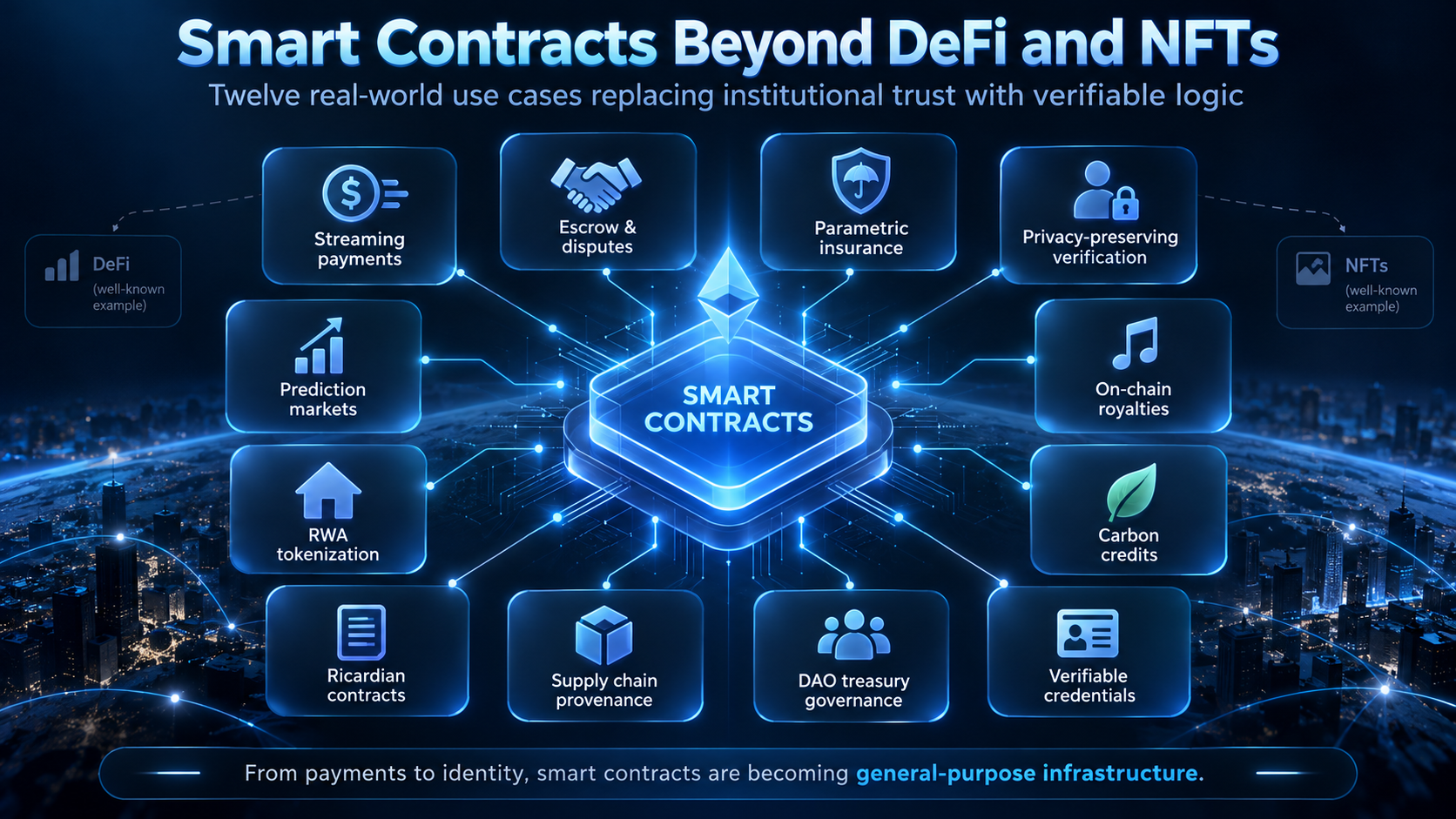
Mention “smart contracts” to most people outside the industry, and two associations come up immediately: decentralised finance and NFTs. That framing was never complete, and it is now years out of date. The same mechanism that automates a token swap or mints a collectible, code that executes a predefined rule the moment a condition is met, turns out to be a remarkably general tool for replacing trust in institutions with trust in verifiable logic.
Over the course of this series, I looked at twelve use cases where smart contracts are already doing real, production work: paying people by the second instead of by the month, settling freelance disputes without a platform taking a cut, paying out insurance claims without an adjuster, proving a fact about yourself without handing over the document behind it, surfacing what organisations actually believe instead of what is politically safe to report, getting musicians paid without a black box swallowing the royalties, moving trillions of dollars of traditional financial assets onto programmable rails, fixing the opacity at the heart of carbon markets, making legal contracts machine-readable, proving a product’s provenance without exposing a supply chain, running DAO treasuries with more discipline than most corporates manage, and replacing the CV with credentials that verify themselves.
None of these are framed as hype. Each article tries to be equally honest about where the mechanism is already working at scale, and where the real constraint, usually an oracle, a standard, or a legal framework that hasn’t caught up, still sits.
The series
- The End of Payday — what happens when the time clock and the paycheck are the same contract, paying by the second instead of by the month.
- No Middlemen, No Chasing Invoices — how smart contract escrow is rewriting freelance trust, without a platform taking a cut to referee it.
- Insurance Without the Argument — parametric insurance, where the claim files itself the moment a verifiable condition is met.
- Your Payslip Is Not Their Business — proving a fact about yourself, like income or employment, without handing over the document it came from.
- The Crowd Knows First — how prediction markets are becoming serious business infrastructure for surfacing what people actually believe.
- The Black Box Is Broken — how smart contracts are rewiring creator royalties and closing the gap where unclaimed income disappears.
- The $450 Trillion Opportunity — what real-world asset tokenisation actually means for capital markets, and why BlackRock is already doing it.
- Greenwashing’s Structural Problem: the On-Chain Fix — fixing the opacity at the heart of the voluntary carbon market.
- When a Contract Can Read Itself — Ricardian contracts, and the case for a single instrument that is both legally binding and machine-executable.
- Prove It Without Showing It — privacy-preserving provenance for supply chains, proving origin and compliance without exposing supplier relationships.
- Beyond the Vote — how DAOs are building the infrastructure for programmable governance of more than $26 billion in on-chain treasuries.
- The CV Is a Trust Problem in Disguise — decentralised, verifiable credentials and what they mean for the future of hiring.
I’ll update each article with links to the one before and after it, so the series reads end to end from wherever you start.