The CV Is a Trust Problem in Disguise: Decentralised Credentials and the Future of Hiring
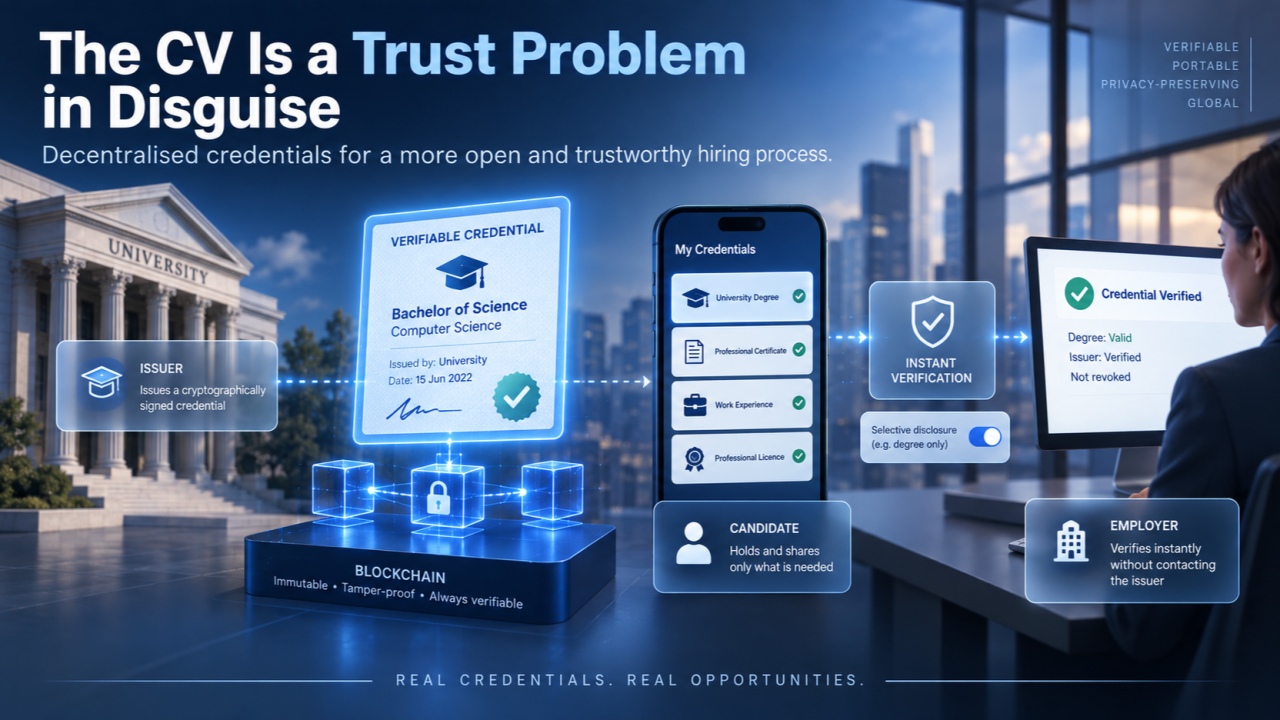
Every hiring process contains a version of the same inefficiency: a candidate makes a set of claims about their qualifications, and the employer must verify them before making a decision. Verifying them means calling or emailing universities, former employers, and professional bodies, each of which has its own process, its own timeline, and its own format for responding. A background check typically takes five business days. A manual university verification often takes longer. A global hire crossing multiple jurisdictions can take weeks.
The underlying problem is not a technology gap. It is a trust gap. A CV is a self-authored document. A PDF diploma can be forged. A LinkedIn profile is unverified by default. The employer cannot know, without checking, whether what the candidate has stated is true and checking is expensive, slow, and still imperfect. 27% of HR managers report encountering fake diplomas in 2024, a number expected to rise as generative AI makes document forgery easier. One in three employers struggle to verify academic credentials manually, delaying hiring by weeks. Universities and employers spend significant resources confirming diplomas via emails and calls, while employers lose $15,000 or more per hire on background check processes.
Blockchain-based verifiable credentials solve this at the architecture level, not the process level.
How verifiable credentials work
The W3C Verifiable Credentials standard, now adopted by the European Union’s Digital Identity framework, the OpenBadge 3.0 specification, and a growing number of national digital identity programmes, defines a structure for issuing cryptographically signed, portable credentials that any verifier can check instantly without contacting the issuer.
The flow has three parties. The issuer, a university, a professional body, a previous employer, a certification authority, creates a credential containing the relevant claim: degree awarded, professional licence held, employment dates and role. The credential is cryptographically signed with the issuer’s private key, which means any modification invalidates the signature. The holder, the candidate, stores the credential in a digital wallet and presents it to verifiers as needed. The verifier checks the cryptographic signature against the issuer’s public key, confirms the credential has not been revoked, and receives instant verification without contacting the issuer at all.
The security comes from blockchain technology, which creates an unchangeable record of qualification. Even if the issuing institution were to close down, the credential would still be verifiable and valid. The verification process checks the institution’s digital signature and views the complete issuance history on the chain, making fraud structurally difficult rather than just detectable after the fact.
Selective disclosure: sharing only what is needed
The more sophisticated version of this, and the one that connects most directly to the privacy-preserving verification thread running through this series, is selective disclosure. A candidate applying for a role requiring a computer science degree does not need to share their grades, their graduation year, their student ID number, or which specific programme they studied, if the only relevant fact is that the degree was awarded by an accredited institution. A zero-knowledge proof of that specific claim can be generated from the full credential and presented without revealing the underlying document.
This is the same cryptographic principle discussed earlier in this series in the context of rental verification, applied to the hiring context. The employer’s legitimate question is narrow: does this person hold the credential they claim to hold? The answer to that question does not require the employer to see the full credential, in the same way that a landlord’s question, can this person afford the rent, does not require them to see a complete bank statement.
For candidates, the practical implication is meaningful: you control what you share, with whom, and for how long. A credential shared for a job application does not need to sit in an employer’s email archive indefinitely. Revocable, time-limited presentations are architecturally possible in a way they are not with document sharing.
Where this is already operating
The EU Digital Identity Wallet, rolling out across member states under eIDAS 2.0, is built on the W3C Verifiable Credentials standard and is designed to include educational and professional credentials as a first-class use case. The European Blockchain Services Infrastructure (EBSI) has already piloted cross-border diploma verification between Belgium and Italy, demonstrating that a degree issued in one member state can be verified instantly by an employer or institution in another.
Several hundred universities globally have begun issuing blockchain-anchored diplomas. Platforms including POK, Verifi.ed, and Accredible now serve more than 1,100 institutions across 19 countries, with over 1.5 million credentials issued. The digital credential management market is projected to reach $1.58 billion as adoption accelerates. By 2026, AI recruitment platforms are beginning to match candidates with opportunities based on their blockchain-verified micro-credential portfolios, reducing the CV to a curated summary rather than the primary evidence document it currently is.
The institutional adoption gap
The technology and the standards exist. The adoption gap is on the employer side. Checking a verifiable credential is faster and cheaper than a traditional background check, but it requires the employer’s applicant tracking system to support the verification protocol and most legacy ATS platforms do not yet. This is the coordination problem that typically precedes a standards tipping point: individual employers have limited incentive to update their infrastructure until enough candidates present verifiable credentials to make the upgrade worthwhile, but candidates have limited incentive to maintain a credential wallet until enough employers can read it.
The regulatory push, primarily from the EU Digital Identity framework, which will make eIDAS 2.0 credentials mandatory for certain public sector interactions, is likely to be the forcing function that breaks this chicken-and-egg dynamic, as it has done for similar credential standards in payments and identity before.
Closing the series
This article completes a twelve-part series on smart contract use cases that go beyond the well-known examples of DeFi and NFTs. The thread connecting all twelve is simpler than it might appear: smart contracts replace trust in institutions with trust in verifiable rules. Whether the application is paying a worker by the second, verifying that a shipment stayed cold, or confirming that a candidate holds a degree they claim, the underlying move is the same. Remove the intermediary whose job was to be trusted. Replace it with code that executes the same way every time, whose behaviour is visible before anyone agrees to anything, and whose record cannot be quietly changed after the fact.
The twelve use cases in this series are at different stages of maturity. Some are operational at institutional scale. Some are in early enterprise deployment. Some are standards-in-progress. All of them are closer than the general conversation suggests, and all of them are happening whether or not any particular organisation decides to engage with them.
This is the twelfth and final article in a twelve-part series on smart contract use cases beyond DeFi and NFTs. Previous: Beyond the Vote. The series starts at Smart Contracts Beyond DeFi and NFTs, covering on-chain time tracking and streaming payments, smart contract escrow, parametric insurance, privacy-preserving verification, prediction markets, on-chain royalties, real-world asset tokenisation, carbon credit verification, Ricardian contracts, supply chain provenance, DAO treasury governance, and decentralised credentialing.