Beyond the Vote: How DAOs Are Building the Infrastructure for Programmable Governance
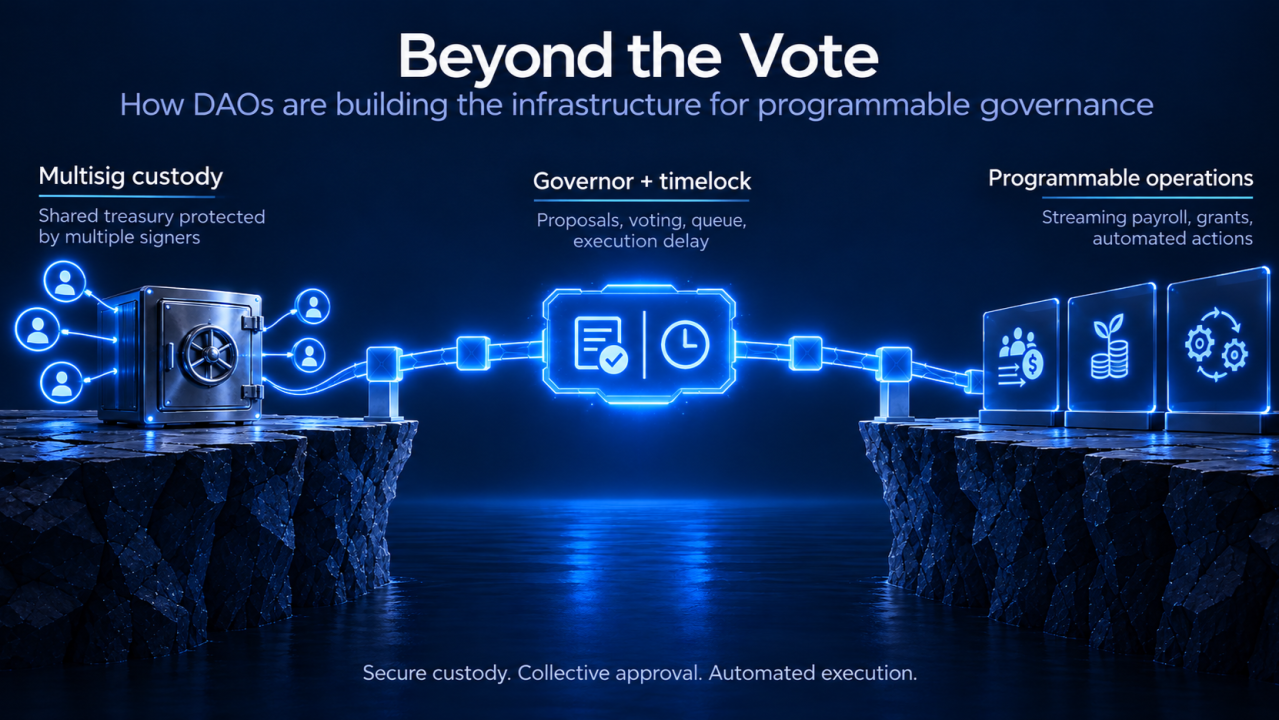
The most common misunderstanding about Decentralised Autonomous Organisations is that they are primarily about voting. They are not. Voting is one mechanism in a broader architecture designed to solve a problem that every organisation with shared assets eventually faces: how do you translate collective intent into controlled on-chain action without making the treasury either unusably slow or dangerously easy to drain?
That tension, between security and agility, between collective legitimacy and operational speed, is the real design problem. The mechanics of multisigs, timelocks, streaming payments, and governor contracts are the engineering answers to it, and they are increasingly mature, battle-tested, and relevant well beyond the crypto-native organisations that pioneered them.
The scale of what is already under management
As of Q1 2026, DAOs collectively control more than $26 billion in on-chain treasuries. Uniswap leads at approximately $4.8 billion, followed by Sky/MakerDAO at $3.9 billion, Optimism at $2.1 billion, Arbitrum at $1.7 billion, and Lido at $1.4 billion. These are not experimental balances. They are live, actively managed pools of capital governing protocol development, contributor compensation, grants programmes, and strategic investments, with every significant transaction publicly auditable on-chain.
The category has shifted from “vote-and-forget” governance to active treasury operations with professional service providers, defined policy frameworks, and recurring reporting. The tooling has matured to match: Safe multisig is the dominant custody layer for DAO treasuries; Tally (now Cactus) and Snapshot handle on-chain and off-chain governance respectively; Sablier and Superfluid run streaming contributor payments; and the asset mix has shifted materially toward tokenised US Treasury bills, Sky alone holds $2.1 billion in tokenised RWA positions, ENS deployed into BlackRock’s BUIDL in 2025, and Optimism’s foundation holds a substantial BUIDL position, connecting the DAO governance world directly to the institutional tokenisation wave.
The three-layer architecture
The governance stack that has emerged across successful DAOs follows a recognisable three-layer pattern.
The first layer is custody: typically a Gnosis Safe multisig, where a defined threshold of elected or appointed signers must collectively approve transactions. A 4-of-7 configuration, for example, means no single actor can move funds unilaterally, and losing access to one or two keys does not freeze the treasury. Multisig-protected DAOs experience 87% fewer successful hacks than those using single-signature wallets, though the coordination cost is real, multisig DAOs take meaningfully longer to respond to security incidents because multiple people must act simultaneously.
The second layer is governance logic: a governor contract that handles proposal creation, voting periods, and queued execution. Any token holder above a defined threshold can submit a proposal specifying a target contract, an amount, a recipient, and a function to call. If the proposal passes the community vote, it moves to a timelock queue. The timelock introduces a mandatory delay between a proposal’s approval and its execution, giving the community a final window to react to any malicious or erroneous transactions, and giving delegates or risk committees time to flag problems before funds actually move. The delay is a feature, not a bug: it is the architectural equivalent of a settlement window.
The third layer is operational automation: the recurring workflows that would otherwise require weekly manual coordination. Contributor payroll runs as streaming payments via Sablier or Superfluid, accruing per second to each recipient’s wallet rather than requiring a multisig signing event every month. Grants disburse in milestone-based tranches, with the smart contract releasing each tranche only when a designated committee confirms the prior milestone was met. Yield strategies deploy idle stablecoins to lending protocols automatically, with governance-approved parameters bounding which protocols, which assets, and what amounts can be deployed without a further vote.
What separates a well-designed from a poorly-designed governance stack
The failure modes in DAO governance are well-documented by now. Voting concentration, where a small number of large token holders can pass or block proposals unilaterally, is addressed by quadratic voting (where power scales with the square root of tokens held rather than linearly) and by delegation systems that distribute effective voting power more broadly. An uncomfortable truth: fully ordinary governance is often too slow for abnormal conditions. If an exploit is active, waiting through a normal proposal period and timelock may convert a recoverable problem into a total loss. That is why many DAOs introduce an emergency council or guardian structure with narrowly scoped authority, but done badly, this reintroduces centralisation through the back door. The design question is not whether to have emergency powers but how to scope, document, and sunset them.
Regulatory uncertainty is also real. The CFTC’s 2023 action against Ooki DAO established that DAO token holders could be treated as a general partnership with joint and several liability, which drove a significant shift toward legal wrappers: Swiss Foundations, Cayman specialised vehicles, and Wyoming DAO LLCs that allow DAOs to hold off-chain assets, sign contracts, and pay taxes while maintaining on-chain governance for internal decisions.
Why this is relevant beyond crypto
The DAO governance stack is, at its core, a solution to a problem that is not unique to crypto organisations: how to manage shared assets with distributed oversight, transparent audit trails, automated execution of routine decisions, and meaningful friction on high-impact ones.
The same architecture, multisig custody, timelock-delayed execution of approved decisions, streaming payments for ongoing obligations, milestone-based tranches for project funding, applies directly to joint ventures, investment syndicates, grant-making foundations, and multi-party research consortia. The technology is production-ready. The legal wrappers exist. The question is whether the operational model is legible enough to traditional finance and legal professionals for adoption to cross the chasm from crypto-native to mainstream institutional.
The evidence from the past two years suggests it is getting there faster than most people expected.
This is the eleventh in a twelve-part series on smart contract use cases beyond the well-known examples of DeFi and NFTs. Previous: Prove It Without Showing It. Next: The CV Is a Trust Problem in Disguise.