Prove It Without Showing It: Privacy-Preserving Provenance in Supply Chains
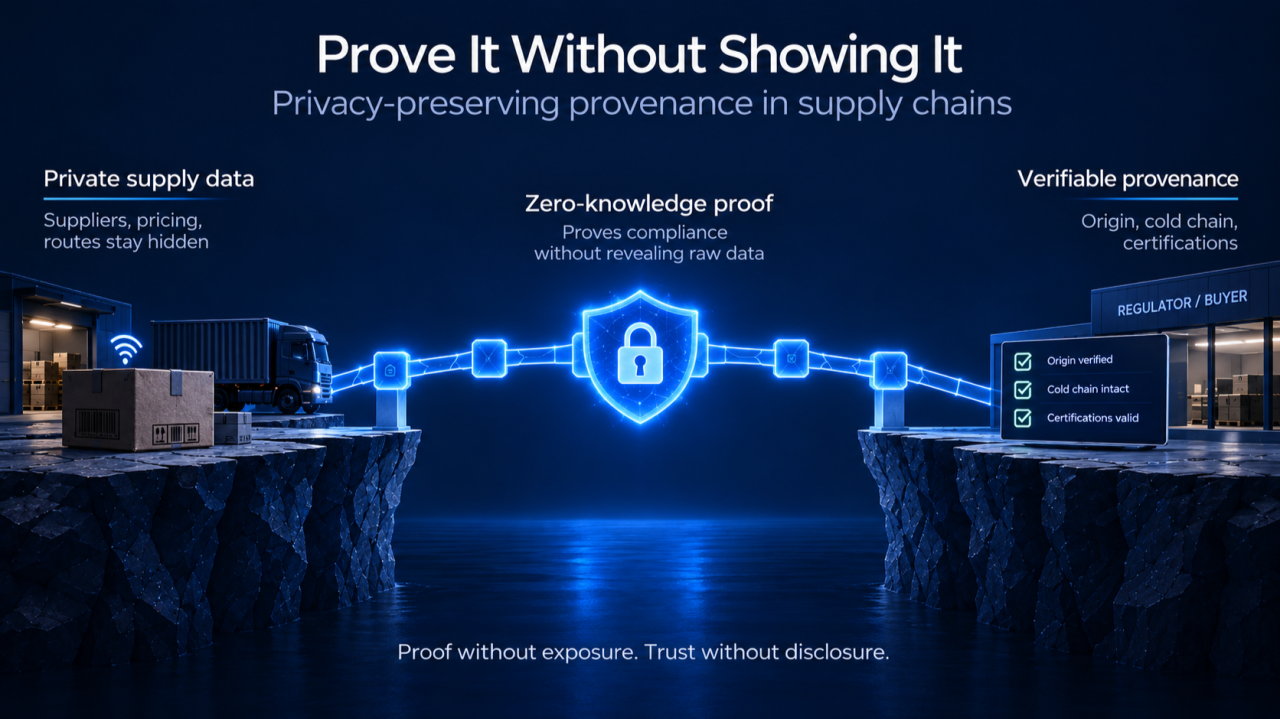
Supply chain provenance has a structural contradiction at its core. Regulators, customers, and partners all want proof: that a shipment stayed within a cold chain, that a material was ethically sourced, that a part came from an approved supplier. But the same participants who need to prove these things are usually unwilling to expose the commercial detail underneath, their supplier lists, their pricing, their logistics routes, to every party in the chain. Transparency and confidentiality are both requirements, and most existing systems force a choice between them.
Why public ledgers and private databases both fail
A fully public ledger solves the trust problem by making everything visible: every transaction, every handoff, every timestamp, verifiable by anyone. But “everyone can verify” also means “everyone can see,” and for most commercial supply chains, that is not an acceptable trade. A competitor can read your supplier relationships, your volumes, your margins, directly off the chain.
A private, permissioned database solves the confidentiality problem by restricting visibility to approved parties. But that reintroduces exactly the trust problem the system was meant to solve: the operator of that private database controls what gets shown, and an external auditor or regulator has no independent way to confirm the records are complete or unaltered. Trust just moved from the paper trail to the system administrator.
The separation that matters
Zero-knowledge proofs resolve this by separating two things that conventional systems bundle together: what must be proven, and what must stay confidential. A zero-knowledge proof allows one party to convince another that a statement is true without revealing the underlying data that makes it true. Applied to supply chains: a supplier can prove that a shipment never exceeded a temperature threshold during transit, without revealing the full sensor log, the carrier used, or the route taken. A manufacturer can prove that a component was sourced from an approved, audited supplier, without revealing which one, at what price, or in what volume.
This is the same cryptographic primitive used elsewhere in privacy-preserving verification, applied here to physical goods rather than financial or personal data. The question a verifier actually needs answered is almost always narrower than the dataset that would answer it, and a zero-knowledge proof lets the answer travel without the dataset attached.
The three-layer architecture
A working privacy-preserving provenance system separates into three layers. The first is data collection: IoT sensors, RFID tags, and ERP system records capture the raw facts, temperature, location, timestamps, custody transfers, as they happen, at the point closest to the physical event. The second is proof generation: a cryptographic circuit takes the raw data and a specific claim, this shipment stayed below 8°C for its entire transit, and produces a compact proof that the claim is true, without the proof itself containing the raw sensor log. The third is on-chain verification: the proof is published to a shared ledger, where any party, a regulator, a customer, an auditor, can verify it instantly against the claim, without needing access to the underlying systems that generated it.
This architecture means the sensitive operational data never leaves the originating company’s own systems. What crosses the boundary is a proof, not a dataset.
Where this is already deployed
The adoption pattern for this is already visible, not speculative. In 2025, an estimated 65,000 smart contracts were executed across logistics and manufacturing supply chains for provenance and compliance verification. Pharmaceutical companies use similar mechanisms to prove cold-chain integrity for temperature-sensitive drugs without exposing full logistics data to every downstream pharmacy. Food safety programmes use it to prove origin and handling claims, organic, fair-trade, sustainably caught, without exposing the full supplier network behind a product. Luxury goods brands use it to prove authenticity and chain-of-custody without revealing sourcing relationships that are themselves competitively sensitive.
The regulatory environment is pushing in the same direction. The EU’s General Product Safety Regulation and Corporate Sustainability Due Diligence Directive, and the US Uyghur Forced Labor Prevention Act, all require companies to be able to prove specific claims about their supply chains, claims about origin, labour conditions, and safety testing, under audit. None of these regulations require companies to make their entire supply chain structure public, which is exactly the gap that privacy-preserving provenance is built to close: provable compliance without full disclosure. The World Economic Forum’s Global Cybersecurity Outlook 2026 found that 65% of large enterprises now cite third-party and supply chain vulnerabilities as a top concern, up from 54% in 2025, which tracks with why this category of tooling is moving from pilot to production.
The honest limitation
The proof is only as good as the data that feeds it, and that is the real constraint on this architecture, generally known as the oracle problem. A zero-knowledge proof can guarantee that the stated claim follows correctly from the data submitted. It cannot guarantee that the IoT sensor was not tampered with, that the RFID tag was not swapped, or that the data entering the system in the first place was accurate. Cryptography secures the proof; it does not secure the sensor. This is why the deployments that are actually working pair the cryptographic layer with tamper-evident hardware and audited data-collection processes, rather than treating the proof itself as sufficient assurance end to end. Anyone adopting this should be clear-eyed about where the trust boundary actually sits: it has moved from “trust the document” to “trust the sensor and the proof circuit,” which is a narrower and more auditable surface, but not a zero-trust one.
What comes next
Having solved verification without disclosure for the physical movement of goods, the next structural question is who controls the capital and decision-making behind the organisations running these systems in the first place, which is where DAO treasury governance comes in.
This is the tenth in a twelve-part series on smart contract use cases beyond the well-known examples of DeFi and NFTs. Previous: When a Contract Can Read Itself. Next: Beyond the Vote.