When a Contract Can Read Itself: The Case for Ricardian Contracts
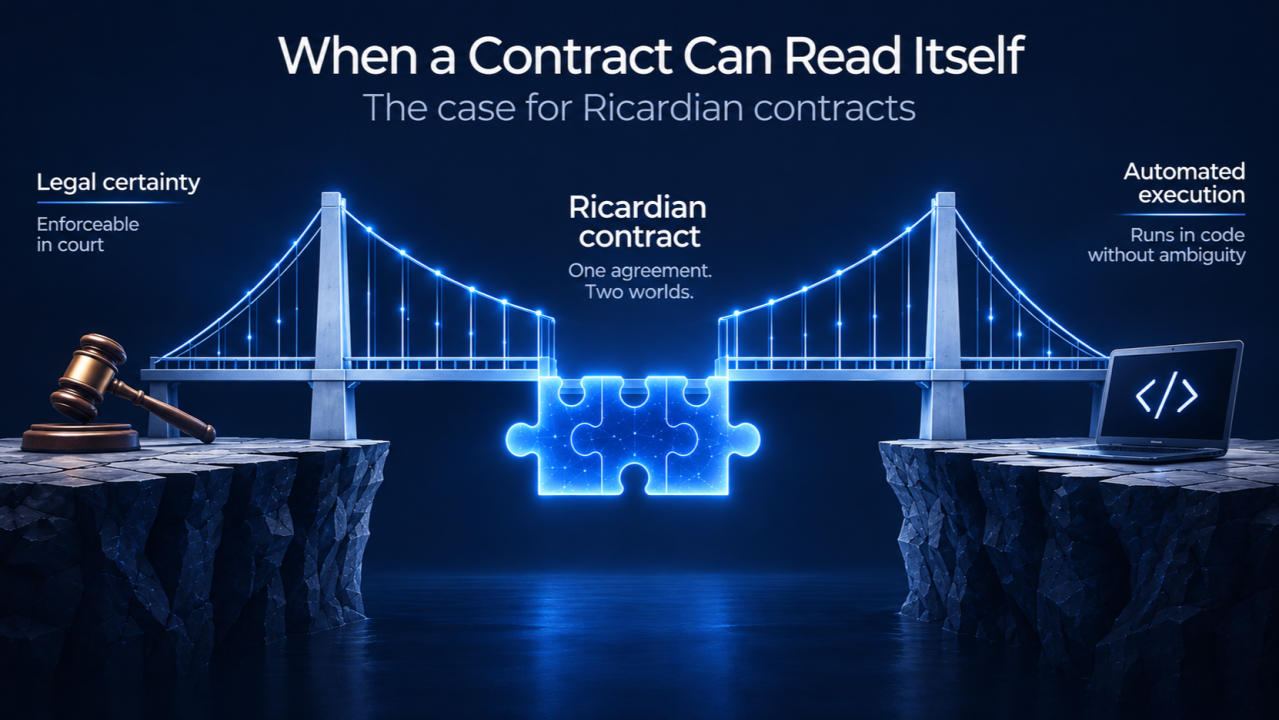
The gap at the centre of smart contracts has always been the same: code is precise but legally inert. A smart contract executes its logic flawlessly, but it does not constitute a legally binding agreement in most jurisdictions. It is a program, not a contract. On the other side of the table, a traditional legal contract is enforceable in court but cannot execute itself. Someone has to read it, interpret it, and act on it, introducing delay, cost, human error, and the possibility of disagreement about what it actually means.
Ricardian contracts were designed in the 1990s by cryptographer Ian Grigg as a direct answer to this gap. The insight was simple: rather than choosing between a legal document and executable code, build a single instrument that serves both purposes simultaneously.
What a Ricardian contract actually is
A Ricardian contract is a document that combines three elements in a cryptographically bound structure: human-readable legal prose that defines the agreement in terms courts can interpret; machine-readable parameters that software can parse and act on; and a cryptographic hash that ties the two together, creating a unique, tamper-proof identifier for that exact agreement. The Ricardian contract captures the essence of the understanding of agreement, whereas the smart contract captures the performance of that agreement, they are two phases of a wider multi-phase project.
The hash is the critical element. It means that any modification to either the legal text or the machine-readable parameters produces a completely different hash, making it immediately detectable. The legal prose and the executable logic cannot diverge silently. They are the same document, cryptographically proven to be identical to what both parties signed.
A more recent formulation describes a Ricardian triple: a tuple of prose, parameters, and code, where the parameters can particularise or specialise the legal prose and the computer code in order to create a single deal out of a template or library of components. This framing is useful because it shows how Ricardian contracts scale: a bank can maintain a library of standard instrument definitions, and each specific transaction becomes an instantiation of a template, with the parameters filled in and the hash computed at deal time.
Why trade finance is the natural starting point
Trade finance is the sector where Ricardian contracts have attracted the most serious institutional attention, and the reason is structural. A typical trade finance transaction, a letter of credit covering an international goods shipment, involves a buyer, a seller, multiple banks, a shipping company, an insurer, and potentially a customs authority. Each party operates a different system. Documents flow between them in formats that were standardised for paper and have been only partially digitised. A single transaction may generate dozens of documents, each of which needs to be checked for consistency with the others before any payment is released.
The result is that trade finance is simultaneously one of the largest markets in the world, financing roughly 80% of global trade, and one of the most expensive to administer per transaction. Processing a paper letter of credit costs an estimated $100-$150 per document in bank administrative overhead, and errors or inconsistencies cause roughly 70-80% of first presentations to be rejected.
A Ricardian contract applied to a letter of credit embeds the terms directly in a machine-readable structure. When documents are presented for payment, the system checks them automatically against the contract parameters rather than relying on a human reviewer to compare text across multiple PDFs. If the conditions are met, the smart contract layer executes the payment. The legal text remains part of the instrument, enforceable in court if a dispute arises, but the routine case, matching conditions met, payment due, requires no human intervention at all.
The AI dimension and autonomous agents
A development in 2026 sharpened why this matters beyond the routine case. In a recent demonstration, AI agents discussed terms, reached an agreement, and created a Ricardian contract containing both human-readable legal language and machine-executable instructions. The contract was linked to a smart contract that automatically triggered a payout when the agreement’s conditions were satisfied. The entire process, from negotiation to execution to settlement, was autonomous. No human reviewed the terms, approved the transaction, or signed anything.
This is not primarily a story about automation for its own sake. It is a story about what becomes possible when AI agents need to transact with each other or with human-operated systems at scale and speed. An AI procurement agent negotiating supply terms needs to produce an agreement that is both interpretable by the counterparty’s legal team and executable by both parties’ systems. A Ricardian contract is the only instrument format that satisfies both requirements simultaneously.
The implication for enterprise systems architects is that the contracts layer of business software, currently an afterthought sitting in document management systems, is about to become a first-class infrastructure concern. When contracts can be both read by lawyers and parsed by machines, the boundary between document management, ERP, and settlement infrastructure dissolves.
The practical gap remaining
Adoption remains early-stage outside specific use cases. The reasons are familiar from other enterprise blockchain initiatives: interoperability across counterparty systems, the need for agreed-upon templates and schemas before the machine-readable layer can be standardised, and the lag between technology availability and legal recognition in different jurisdictions. The Accord Project has done important work on open-source Ricardian contract templates and tooling, and enterprise platforms including R3 Corda have built Ricardian contract support into their architecture. But the network effects that make a standard useful have not yet reached critical mass outside trade finance.
The direction is clear. The question is whether the standardisation effort moves fast enough to get ahead of the AI agent economy that is arriving whether or not the contract infrastructure is ready for it.
This is the ninth in a twelve-part series on smart contract use cases beyond the well-known examples of DeFi and NFTs. Previous: Greenwashing’s Structural Problem: the On-Chain Fix. Next: Prove It Without Showing It.