Greenwashing's Structural Problem: the On-Chain Fix
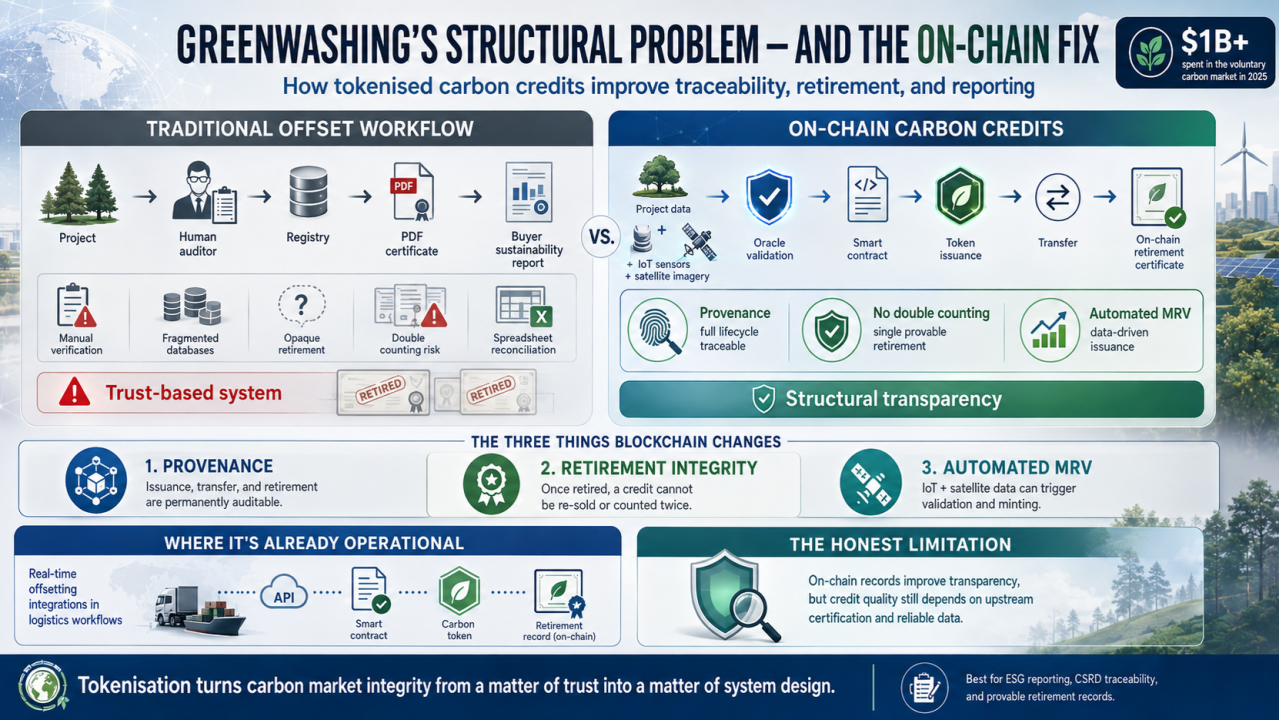
In 2025, the voluntary carbon market crossed $1 billion in spending. That sounds significant until you look at the mechanism underneath it. A company purchases carbon credits to offset its reported emissions. Those credits come from a project, a reforestation scheme, a methane capture facility, a clean cookstove program, that was assessed by a human auditor, certified by a registry, issued a paper or database certificate, and listed for sale. The buyer retires the certificate, receives a PDF confirmation, and records the offset in their sustainability report.
At every step, the process depends on human judgment, manual record-keeping, and a chain of trust between parties operating separate systems. The structural vulnerability is not bad faith, though that has occurred, it is opacity. When each stage happens in a different database, with different standards, across different jurisdictions, double counting becomes possible, quality becomes hard to verify, and the buyer has almost no way to confirm that the credit they purchased actually represents what it claims to represent.
This is precisely the kind of problem smart contracts are well-suited to solve.
The three things blockchain changes
The first is provenance. When a carbon credit’s full lifecycle, from project registration to issuance, transfer, and retirement, is recorded on an immutable ledger, every step is permanently traceable. Blockchain records each credit on an immutable ledger, meaning every step in a credit’s lifecycle, from issuance to retirement, can be verified. A buyer can audit not just the certificate but the entire history of the instrument they are purchasing, including who issued it, on what basis, and whether it has ever been transferred or partially retired before.
The second is double counting elimination. The structural impossibility of spending the same token twice on a blockchain directly addresses the most serious integrity problem in the voluntary carbon market, the same credit being sold or retired in multiple registries simultaneously. The on-chain retirement of a credit generates an instant, provable retirement certificate on blockchain rather than a PDF from an opaque registry, creating a structural impossibility of double counting that eliminates a major category of greenwashing risk.
The third is automated measurement and verification. The most labour-intensive part of carbon credit issuance is the MRV process, Measurement, Reporting, and Verification, which traditionally requires periodic human audits. Smart contracts connected to oracle networks can automate this. If IoT or satellite data meets the verified criteria, the smart contract can automatically unlock funding or mint new carbon credits. This automated MRV reduces reliance on slow human auditors and increases trust in data integrity. A reforestation project with sensors measuring tree growth and satellite imagery confirming canopy coverage can issue credits continuously as verified sequestration occurs, rather than in annual batches following an audit.
Where it is already operational
Maersk and Amazon have begun integrating tokenized fuel-offsetting credits into their logistics APIs. Rather than calculating emissions annually, companies offset in real time as logistics events are recorded. The architecture in these implementations combines IoT data ingested via decentralized oracles, cross-referenced against satellite imagery, with smart contracts that only mint tokens after validation, and issue a non-transferable on-chain certificate when a credit is retired, suitable for ESG filings.
The regulatory pull is also sharpening. The CSRD, Europe’s Corporate Sustainability Reporting Directive, extends its scope in 2026 to listed companies with more than 250 employees, requiring end-to-end traceability for reported offsets, instant and provable retirement records, and automated reporting compatible with ESRS formats. A verifiable on-chain retirement certificate directly satisfies these requirements in a way that a PDF from a registry does not. For companies subject to CSRD or EU ETS reporting obligations, on-chain credits are not just a cleaner alternative, they increasingly look like the lower-compliance-risk option.
The global voluntary carbon credit market reached approximately $15.8 billion in 2025, with buyers increasingly paying a premium for high-integrity, verifiable credits over low-cost alternatives with opaque provenance.
The honest limitation
Moving a credit on-chain does not make it real. As JPMorgan has noted in its own blockchain carbon registry work, the platform is not an authority on credit quality, it only enforces standardized data structures. Rigorous auditing and certification from well-respected entities such as Verra and Gold Standard will still be crucial.
This is the oracle problem applied to carbon markets: the on-chain record is only as trustworthy as the off-chain measurement and verification process that feeds it. A fraudulently issued Verra credit that is subsequently tokenized is still a fraudulent credit. What blockchain adds is a guarantee that the same credit cannot be double-counted or secretly re-sold after retirement, not a guarantee that the underlying project delivered what it claimed.
The correct framing is that tokenization makes the integrity of carbon markets a matter of structural design rather than institutional trust. It removes one class of failure completely (double counting, re-selling, opaque retirement) while leaving another class (project quality, measurement accuracy) as a function of the certification standards applied upstream. For buyers doing due diligence, that distinction matters. It means asking not just “is this credit on-chain” but “which registry certified it and on what methodology.”
The strategic implication
For sustainability officers and CFOs managing ESG reporting obligations, the practical question is timeline and tooling. The infrastructure is live, the regulatory incentive is clear, and the integrity advantage over traditional certificates is structural rather than marginal. The companies currently building direct integrations between their logistics systems and tokenized credit registries, as Maersk and Amazon are doing, will have a materially simpler compliance posture in 2027 than those still managing offset portfolios through PDF certificates and spreadsheet reconciliation.
This is the eighth in a twelve-part series on smart contract use cases beyond the well-known examples of DeFi and NFTs. Previous: The $450 Trillion Opportunity. Next: When a Contract Can Read Itself.