The $450 Trillion Opportunity
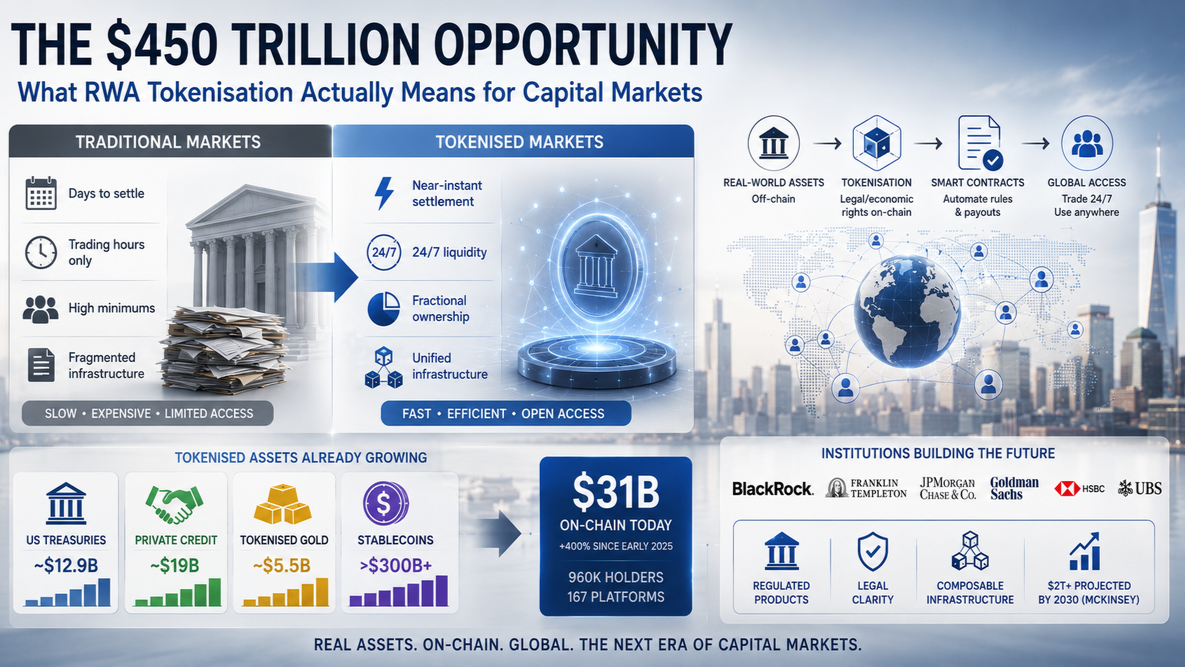
In March 2024, BlackRock, the world’s largest asset manager, launched a tokenised money market fund on Ethereum. By July 2026, that fund, known as BUIDL, had crossed $2.5 billion in assets, distributed over $100 million in dividends, expanded to nine blockchain networks, and become tradeable on Uniswap, placing a regulated institutional product on a decentralised exchange for the first time.
This is not a crypto story. It is a capital markets infrastructure story. And the signal is unambiguous: the shift that practitioners in this space have been describing for years is now being executed by the institutions that run the traditional financial system.
What tokenisation actually means
Real-world asset tokenisation is the process of creating a blockchain token that represents legal or economic rights to an asset that exists off-chain. The critical point, one that gets lost in the hype, is that the token is not the asset. A token representing a share in a building is not the building. What the token provides is a programmable, transferable, on-chain record of ownership that carries the same legal claim as the paper instrument it replaces, while removing the frictions that paper instruments carry.
Those frictions are not trivial. Traditional capital markets operate on settlement cycles measured in days. Liquidity windows are confined to trading hours in specific time zones. Minimum investment thresholds exclude all but the largest institutions from most asset classes. Private markets, private credit, real estate, infrastructure, are largely inaccessible outside a narrow circle of allocators, because the overhead of managing thousands of small investors across a traditional fund structure is prohibitive.
Tokenisation removes each of these constraints simultaneously. Settlement becomes atomic and near-instantaneous. Liquidity becomes continuous. Minimum investment drops to whatever fraction of a token is economically meaningful.
The scale of what is already in motion
The total value of tokenised real-world assets on public blockchains reached $31 billion as of July 2026, up more than 400% since early 2025, held across 167 platforms by nearly 960,000 holders. Ethereum leads with roughly 65% of tokenised value. Tokenised US Treasuries stand at approximately $12.9 billion, private credit at around $19 billion, and tokenised gold at $5.5 billion. Add stablecoins, technically tokenised dollar claims and the settlement layer on which much of this moves, and the broader market exceeds $300 billion.
The institutions driving this are the largest names in traditional finance, not crypto-native startups. BlackRock’s chief executive has compared tokenisation’s current stage to where the internet was in 1996, describing a future of one general ledger on which all assets are tokenised. Alongside BUIDL sit Franklin Templeton’s BENJI token (the first SEC-registered tokenised mutual fund on a public blockchain), JPMorgan’s tokenised transaction infrastructure, and active programmes at Goldman Sachs, HSBC, and UBS. The NYSE has announced a dedicated venue for 24/7 trading and settlement of tokenised securities. McKinsey projects the tokenised asset market could reach $2 trillion by 2030.
Why the hard problems are still ahead
The $31 billion figure is real, but it represents the easiest segment of the opportunity: tokenised Treasuries and money market funds, where the underlying assets are highly standardised, the legal framework is clear, and the investor base is institutional.
The harder segment, corporate bonds, equities, real estate, private credit, structured products, runs into problems that the current wave of adoption has not yet had to solve. Without a common language for describing what a tokenised instrument is, its cash flows, its lifecycle events, its redemption conditions, each new issuance requires bespoke integration at every counterparty junction. Initiatives like ACTUS (Algorithmic Contract Types Unified Standards) point toward a solution, defining not just the token wrapper but the contract logic itself, making financial products self-describing and enabling automated corporate actions on-chain. But adoption remains early-stage.
Corporate actions are worth calling out specifically. One of the most labour-intensive, error-prone processes in post-trade infrastructure, handling coupon payments, rights issues, redemptions, rate resets across thousands of positions, could be automated entirely if the product definition lived on-chain with its event logic embedded. That is the promise. The gap between promise and current reality is largely a standardisation problem, not a technology one.
The smart contract layer and composability
What makes this more than a database upgrade is the programmability of the token itself. BUIDL was accepted as collateral on Binance in November 2025 and became tradeable on Uniswap in February 2026, moving composability from theoretical to operational. A tokenised asset can plug into other smart contract systems: posted as margin, used to earn yield while remaining available for same-day settlement, or held fractionally by an investor who previously had no access to the underlying asset class.
This composability is what distinguishes on-chain tokenisation from prior attempts at digital securities. A PDF-based digital bond is a record. A programmable on-chain bond is an instrument that can interact with the broader financial system autonomously, executing its own lifecycle events and integrating with other contracts without human intervention at each step.
The honest risks
Two risks deserve direct naming. The first is legal: a token is only as good as the enforceability of the claim it represents. If the underlying asset is in a jurisdiction that does not recognise the token as a valid instrument, the holder has a technical record but may lack legal recourse. This is why current institutional adoption concentrates in asset classes with clear regulatory treatment.
The second is oracle dependency: a tokenised bond paying interest via smart contract needs a reliable on-chain data feed for the rate calculation. The quality of the programmable layer depends entirely on the quality of the data feeding it.
Neither risk negates the direction of travel. They define where the remaining engineering and legal work is concentrated.
The practical implication
For finance professionals, the question is not whether to engage with tokenisation but in which asset classes and on what timeline. Treasury and money market products are already operational at institutional scale. Private credit is moving fast. Real estate and infrastructure are earlier-stage but directionally clear.
The gap between $31 billion today and $2 trillion by 2030 represents an enormous amount of work, and an enormous amount of opportunity for the institutions that build the pipes. The ones building now will not just capture market share; they will set the standards that everyone else integrates with.
This is the seventh in a twelve-part series on smart contract use cases beyond the well-known examples of DeFi and NFTs. Previous: The Black Box Is Broken. Next: Greenwashing’s Structural Problem: the On-Chain Fix.