The Black Box Is Broken: How Smart Contracts Are Rewiring Creator Royalties
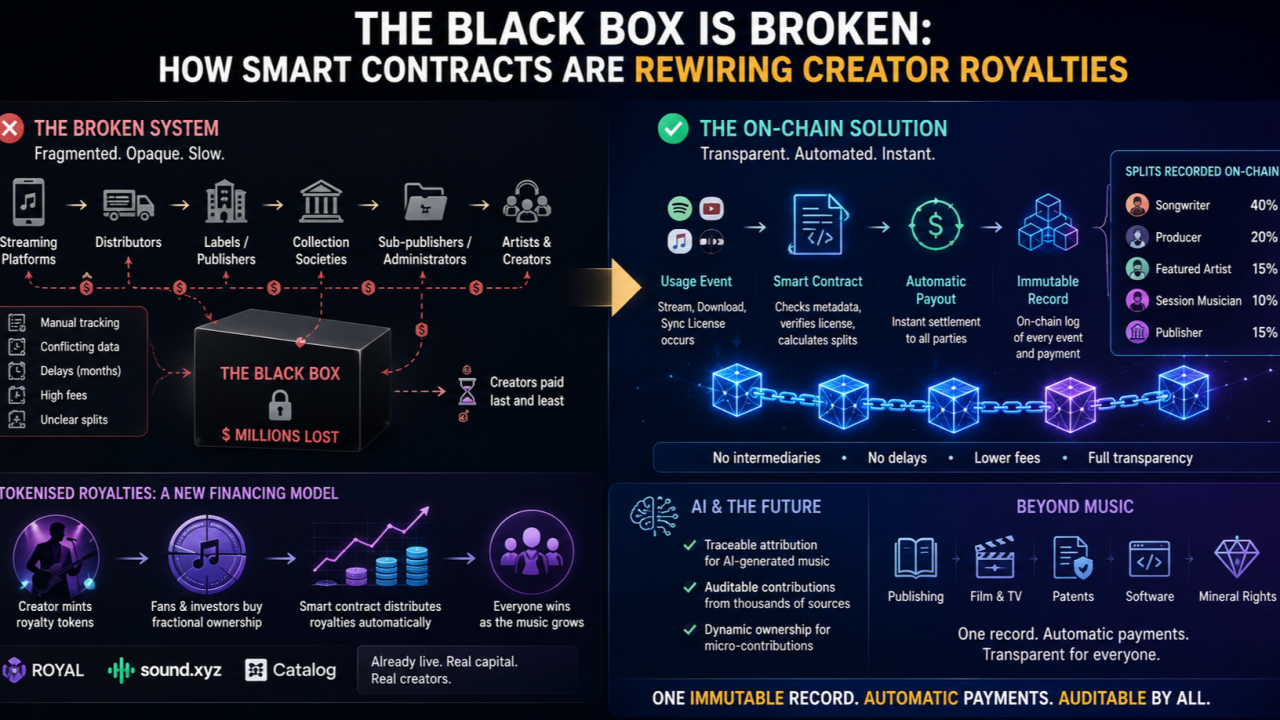
Ask a session musician how long they wait between a recording being streamed and receiving their share of the revenue. The answer, if they receive anything at all, is usually months. Ask a songwriter how they know their published split percentages are being applied correctly across every digital service provider in every territory. The honest answer is: they largely cannot know, because the system that tracks it is fragmented across collection societies, publishers, labels, and distributors, each operating their own ledgers, applying their own administrative fees, and passing reduced amounts downstream on schedules that were designed for a physical distribution world.
The industry even has a name for money that gets lost in this system: the black box. It refers to royalty income that is collected but cannot be paid out because the rightsholder cannot be identified, or because conflicting metadata across different systems means no one agrees on who owns what percentage. Estimates of unclaimed royalties sitting in these boxes run into the hundreds of millions annually.
Smart contracts do not solve every problem in music or creative rights, but they address this specific failure directly.
What the mechanism actually does
The starting point is registration. When a track is created, its ownership is recorded on-chain: composer shares, producer splits, featured artist percentages, session musician credits. This immutable record becomes the single source of truth that all subsequent payments reference. Because the ledger is decentralised, it cannot be unilaterally altered by any single party after the fact, which eliminates the most common source of royalty disputes.
When a usage event occurs, a stream, a sync licence, a download, the smart contract checks the metadata linked to the track, confirms the applicable licence tier, calculates the payout, and executes the transaction. Unlike traditional contracts, which require manual tracking and multiple intermediaries, smart contracts are coded to trigger royalty transactions instantly once a specific condition, such as a stream, download, or sync licence, is met. Each party receives their fraction directly, without any intermediary holding the consolidated payment and redistributing it later.
The black box problem specifically is addressed by making ownership registration a precondition for payment. When a new track is registered on-chain, all associated metadata is cryptographically secured and timestamped, including the exact split percentages agreed upon by the songwriters, producers, and publishers. Because the ledger is decentralised, it creates a single source of truth that cannot be unilaterally altered or manipulated by any single party.
Tokenised royalties: a second dimension
Beyond automating payments, smart contracts enable something structurally new: turning a royalty stream into a tradeable asset.
Tokenised royalties are digital assets representing fractional ownership of a revenue stream, such as music copyrights, patents, or mineral rights. By recording ownership on a blockchain, creators can automate revenue distribution via smart contracts, providing investors with liquid, tradeable assets and transparent payout histories while granting creators immediate access to capital.
The practical consequence is a new financing route for creators that does not require signing away rights in perpetuity. Record labels and publishers often provide advances in exchange for owning the master rights and taking a large percentage of future earnings. Tokenised royalties allow creators to raise capital directly from their audience without losing creative control or signing away their rights. A musician can sell fractional ownership of a specific album’s streaming income, represented as tokens, to fans or investors, receive the capital upfront, and have the smart contract automatically distribute returns to token holders as revenue comes in. The token holders become financially aligned with the work’s success, which changes the relationship from passive consumption to shared ownership.
Platforms including Royal, Sound.xyz, and Catalog are already running on these mechanics. Royal lets artists sell song rights as NFTs, with buyers earning a share of future royalties automatically. Sound.xyz enables artists to release songs where fans mint numbered editions and receive early access revenue. These are not theoretical pilots, they are live products through which artists have already raised meaningful capital outside the traditional label system.
The AI attribution problem, and what smart contracts cannot do
The arrival of AI-generated music sharpens the royalty problem considerably, but it is worth being precise about where smart contracts help and where they do not, because the temptation to oversell them here is real.
An AI music model trained on millions of samples may generate output that draws on the style, structure, or timbral qualities of hundreds of source recordings simultaneously. The concept of static ownership is evolving toward something more like dynamic participation, artists earning not just from finished songs but from micro-contributions across countless generated outputs. Without an immutable, machine-readable record of what was contributed and by whom, administering those micro-contributions at scale is impossible.
That is the problem. Here is the honest limitation: a smart contract cannot listen to a piece of AI-generated music and determine which training samples influenced it. Attribution, figuring out what went into a generated output, and in what proportion, is a machine learning problem, not a contract problem. It requires techniques like audio fingerprinting, source similarity detection, and influence functions built into the generative model itself, which can log which training examples most shaped a specific output. That research is active but unsolved. Most music AI models to date were trained on datasets assembled without clear licensing, which is precisely why there are active lawsuits against AI music companies. Smart contracts cannot retroactively create attribution records for training data that was never registered.
What smart contracts can do is manage the royalty payment layer once attribution has been determined by other means. If a generative model is built from the ground up to register every training sample on-chain with a cryptographic hash and a rights holder identity, and if the model produces an attribution vector alongside each generated piece, a log of which samples had the highest influence weight, then a smart contract can take that vector and automatically calculate and distribute royalty splits according to pre-agreed rules. The logic is transparent and auditable before any generation happens, which is a meaningful improvement over trusting a company’s internal accounting.
The threshold problem remains unresolved even in this best-case architecture: when a generated piece has diffuse influence from tens of thousands of samples each contributing a fraction of a percent, paying every rights holder their proportional share produces micropayments too small to process economically. Some form of pooling or collective licensing is needed, which reintroduces an intermediary and partly recreates the very opacity smart contracts were meant to remove.
The honest framing is this: smart contracts provide a trustworthy enforcement layer for AI music royalties, but only once the upstream attribution problem has been at least partially solved. The two need to arrive together. The contract layer will be ready before the attribution layer is, and the gap between them is where the next wave of legal disputes will be fought.
What this means beyond music
The royalty problem is not unique to music. The same pattern, fragmented ownership records, slow and opaque payment chains, unclaimed income sitting in administrative black boxes, exists in publishing, patent licensing, film and television synchronisation rights, open-source software contribution, and mineral rights. In each case, the same infrastructure applies: register ownership on-chain at creation, define split logic in the contract, automate distribution when usage is verified.
The question for anyone managing a complex revenue-sharing arrangement is not whether this technology exists. It is whether the administrative cost and opacity of the current system is worth maintaining when the alternative is a single immutable record that pays all parties automatically and is auditable by everyone simultaneously.
This is the sixth in a twelve-part series on smart contract use cases beyond the well-known examples of DeFi and NFTs. Previous: The Crowd Knows First. Next: The $450 Trillion Opportunity.