The Crowd Knows First
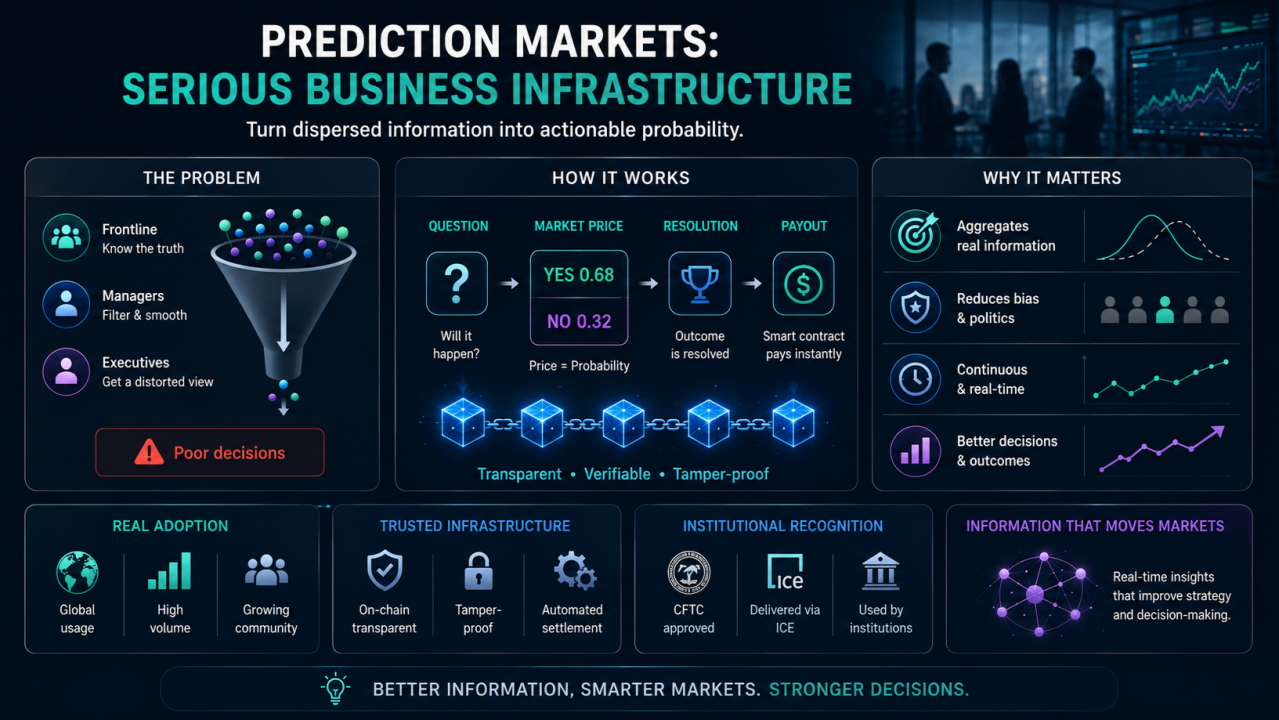
There is a well-documented failure mode in organisations: the people closest to the truth often have the least influence over decisions. A sales team knows a deal is unlikely to close. A factory floor knows a product launch is behind schedule. A research team knows an assumption in the strategy deck is wrong. And yet, because information flows upward through layers of reporting that filter, smooth, and politically reshape it, the decision-maker at the top receives a version of reality that differs meaningfully from the one on the ground.
Prediction markets were originally a mechanism for aggregating dispersed, privately-held information into a single, public probability signal. The insight behind them, that people with skin in the game will reveal what they actually believe more reliably than they will report it, has been academically validated for decades. What changed recently is the infrastructure. Smart contracts made it possible to build prediction markets that are transparent, globally accessible, automatically settled, and not dependent on a central operator to be trustworthy.
How the mechanic works
A prediction market is a marketplace for binary outcomes. Participants buy contracts on whether a specific event will occur. The price of a contract reflects the market’s collective probability estimate: a contract trading at $0.70 implies a 70% chance the event happens, paying $1 if it does and $0 if it does not. That price is set not by an algorithm but by the aggregate of everyone who has put money behind their view, which means it continuously incorporates new information as participants trade on what they know or observe.
The smart contract layer handles settlement automatically. When the outcome is resolved, the event happened or it did not, the contract pays winners from the pool without a central operator making a judgment call. Resolution rules are defined upfront and publicly readable before anyone takes a position. Polymarket’s on-chain architecture allows traders to verify market mechanics, track order flow, and confirm payouts without relying on centralised intermediaries.
Beyond betting: the forecasting use case
The most interesting version of this for a business audience is not trading on political outcomes or sports results. It is using the same mechanism to surface internal information more honestly.
Several large organisations have run internal prediction markets, sometimes called decision markets or information markets, where employees bet on operational outcomes: will this project ship on time, will this product hit its sales target, will this hire succeed in the role. The results consistently show that internal markets surface information that management surveys, status updates, and meetings do not. People reveal what they actually expect when there is a cost to being wrong, rather than what they think their manager wants to hear or what is politically safe to say.
The external version of this is now mainstream infrastructure. On 28 February 2026, Polymarket set a single-day trading volume record of $425 million, a signal of how rapidly these markets have scaled from niche infrastructure into mainstream forecasting tools. Metaculus, which operates without financial stakes, has aggregated more than 80,000 community forecasts across science, technology, and geopolitics, and its aggregate forecasts have been shown to fall within 2-3% of perfect calibration across thousands of resolved questions. The platform is used by researchers, think tanks, and government agencies as a tool for aggregating expert opinion.
The institutional dimension is shifting too. Polymarket’s real-time pricing data now reaches institutional capital markets clients through Polymarket Signals and Sentiment, delivered via ICE’s distribution infrastructure, marking a shift from prediction markets as retail speculation to prediction markets as institutional information infrastructure.
The oracle problem, revisited
As with parametric insurance, the credibility of prediction market settlement depends on the quality of the data used to resolve outcomes. For objective, measurable events, a flight’s departure time, a rainfall figure, a published GDP number, smart contract settlement is clean and unambiguous. For more subjective outcomes, resolution depends on agreed sources and, when those sources conflict, on community governance or designated arbitrators. This is the version of the oracle problem that prediction markets have not yet fully solved: not the data feed, but the judgment call about what “counts” as an event having occurred.
The most serious structural criticism of financial prediction markets is also worth naming: they can be moved by large, concentrated positions, particularly when liquidity is thin. During the 2024 election cycle, questions arose about large concentrated positions potentially distorting market probability estimates on Polymarket, illustrating both the transparency benefits of on-chain markets (the positions were publicly visible) and the challenges of interpreting prices when liquidity is concentrated. Transparency is necessary but not sufficient for accuracy.
The business takeaway
The practical question for organisations is not whether to trade on Polymarket. It is whether the information-aggregation mechanic, financially incentivised, anonymous, continuously updated, could surface things that internal reporting structures systematically conceal. A project that everyone privately expects to be late but no one will say is late in a status meeting is a canonical example of the kind of information these markets were designed to reveal.
The regulatory path is also clearer than it was. The CFTC approved Polymarket’s Amended Order of Designation, permitting the platform to operate under the full set of federal rules for US exchanges, the first instance of an on-chain prediction market being integrated into the US regulatory framework. As regulated, institutionally accessible prediction markets become a standard part of the information landscape alongside polling and economic forecasting, the question of how to use them as an input to decision-making becomes less exotic and more operational.
This is the fifth in a twelve-part series on smart contract use cases beyond the well-known examples of DeFi and NFTs. Previous: Your Payslip Is Not Their Business. Next: The Black Box Is Broken.