The End of Payday
Every payroll system in the world, from a corner shop to a multinational, still runs on the same basic logic it did fifty years ago: an employee or contractor logs hours somewhere, that record gets reviewed and approved, and then, on a fixed date, a payment is issued. Three separate systems, three separate sources of truth, and a gap of days or weeks between work performed and money received.
That gap is not just an inconvenience. It is the reason earned-wage-access apps and invoice-factoring services exist as entire industries: businesses built solely to bridge the time between “you did the work” and “you got paid.” It is also a source of quiet friction and disputes, since the time record, the approval, and the payment all live in different systems that someone has to reconcile by hand.
Smart contracts make it possible to collapse all three into one.
Beyond “automatic payment”: making the clock itself on-chain
Most discussions of blockchain payroll stop at automating the payment step: someone logs hours in a spreadsheet or an app, and a smart contract pays out on a schedule. That is an improvement, but it leaves the actual point of failure untouched, because the time record itself still lives off-chain, in a system someone could edit, lose, or dispute.
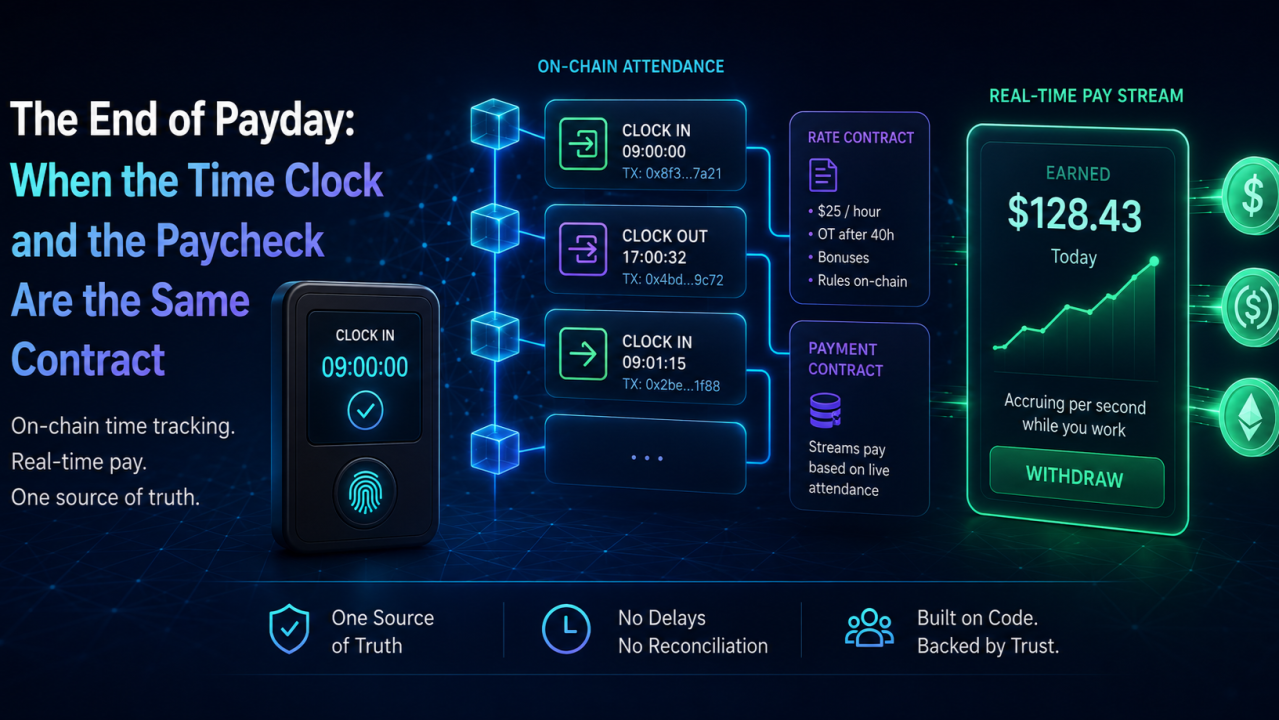
The more interesting version of this is one where the clock-in/clock-out event is itself a transaction on the blockchain, not an entry in a database that merely feeds one. When a worker clocks in, that action is written directly to the chain. When they clock out, that is written too. There is no intermediate export, no batch upload, no “trust us, the timesheet is accurate.” The payment smart contract does not receive a report about hours worked; it reads the hours directly, from the same ledger, in real time.
This is the same architectural shift that token-streaming protocols like Sablier and Superfluid have already made for the payment side, where a sender deposits tokens into a smart contract that releases them incrementally over time, with the recipient able to withdraw continuously as the balance accrues. What changes here is the trigger. Instead of streaming purely on a clock, the contract streams against verified, on-chain attendance: pay accrues only while a clock-in event is open, calculated to the second, and stops the instant a clock-out is recorded.
How the mechanics fit together
The architecture has three components, and the key design decision is that all three reference the same chain instead of passing messages between separate systems.
The attendance contract. Clock-in and clock-out actions are submitted as on-chain transactions, timestamped by the blockchain itself rather than by a device or app that could be manipulated. To prevent a worker from clocking in from home and claiming presence at a job site, this can be paired with verifiable location or device-attestation data, but the critical point is that once submitted, the record is immutable and visible to both parties.
The rate contract. A simple, auditable rule set defining pay rate, overtime thresholds, and any conditional bonuses, also stored on-chain so neither party can quietly alter it after the fact.
The payment contract. This is the streaming layer. It reads state directly from the attendance contract, much like a closed-ended payment stream where a start and end time are recorded on the blockchain and the recipient’s allocation increases every second between those bounds. The difference is that the start and end times are not pre-agreed; they are live events generated by the clock-in/clock-out contract itself. The moment a clock-out transaction lands, the payment contract simply stops accruing. No invoice, no approval queue, no manual reconciliation.
Why this matters more than it sounds like it should
The obvious objection is: why does this need a blockchain? A well-built internal app could log time and trigger payments too.
The answer is the same reason DAOs have moved payroll and grants onto these rails despite having every incentive to use something simpler: the resulting streams are visible on-chain, auditable by anyone, and unwindable if the sender retains cancellation rights, which is what makes this approach preferable to off-chain spreadsheets for distributing funds. The same logic applies to time tracking. When the clock-in record and the payment logic both live on a shared, tamper-resistant ledger, three problems disappear simultaneously:
Disputes over hours worked become close to impossible, because there is one record, not a worker’s app and a manager’s spreadsheet that may disagree. Payment delay disappears, because there is no batch process between “shift ended” and “money available,” the same way streams continue automatically without repeated manual transactions once they are opened. And trust between parties who don’t know each other well, such as a company hiring international contractors or gig workers, no longer depends on either side’s internal systems, because the rules are enforced by code both sides can independently verify.
Where this is headed
This is not a hypothetical mechanic. Superfluid pioneered the idea of continuous, per-second token flows calculated directly within smart contracts specifically because it is well suited to recurring payments like salaries, and organizations are already using these primitives for vesting, payroll, and grant disbursement, with the contract-level visibility being the selling point over traditional offchain processes. The next logical step, tying the input event, time worked, directly to the same trust layer as the payment, closes the last gap between doing the work and being paid for it.
For gig platforms, international contractor payments, hourly retail and hospitality work, or any relationship where “did the hours actually happen as claimed” is a recurring source of friction, this is worth watching closely. It is not just faster payroll. It is payroll where the time clock and the paycheck can no longer disagree with each other, because they are reading from the same source of truth.
This is the first in a twelve-part series on smart contract use cases that go beyond the well-known examples of DeFi and NFTs. Next: No Middlemen, No Chasing Invoices.