No Middlemen, No Chasing Invoices
Ask any freelancer what the worst part of the job is, and “finding clients” is rarely the top answer. It’s getting paid for work already delivered. Net-30 terms that quietly become net-60. Clients who go dark after the final file is sent. Platforms that hold 15-20% of every payment as the price of “protection” that mostly amounts to a support ticket queue.
Smart contract escrow is quietly replacing that entire model, and not with a marginal tweak. It removes the middleman whose job was to be trusted, and replaces it with code whose behavior is fixed and visible before either party agrees to anything.
The basic mechanic
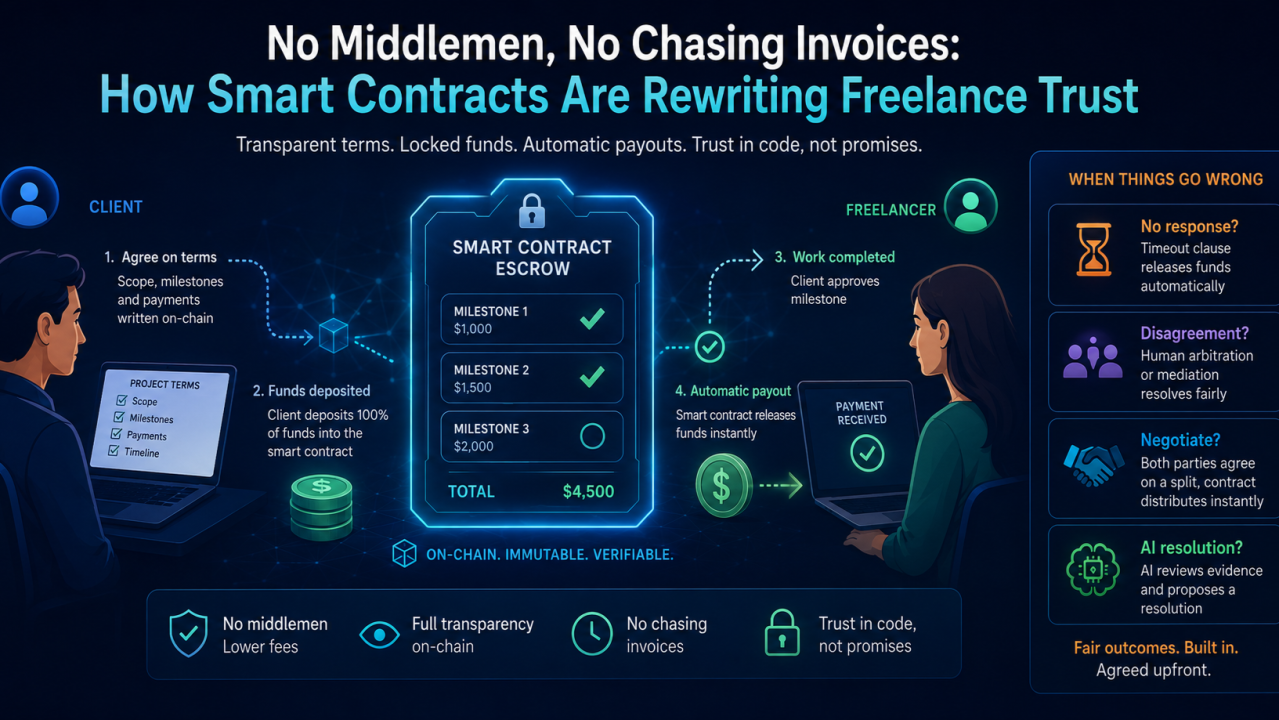
The structure is simple enough to explain in four steps. A client and freelancer agree on scope, milestones, and payment amounts, and those terms are written directly into a smart contract rather than a PDF nobody fully reads. The client deposits the full project funds upfront into that contract, where they are locked, visible on-chain, and provably set aside, not just promised. As the freelancer completes each milestone, the client reviews and approves it, which triggers an automatic, partial release of funds for that portion of the work. Once all milestones are approved, any remaining balance releases and the relationship closes out, with the full payment history sitting on an immutable ledger that both sides can independently verify.
The meaningful shift is in where the trust lives. In a traditional arrangement, the freelancer trusts the client to actually pay once work is done, and the client trusts the freelancer to deliver before paying. A platform middleman exists to referee that mutual uncertainty, and charges accordingly. In a smart contract escrow, both sides know the money already exists and is contractually committed to release under specific, pre-agreed conditions, before a single hour of work is logged.
What happens when something goes wrong
The honest test of any escrow system isn’t the happy path, it’s the dispute. This is where most of the recent design work in this space has gone, and it’s worth separating into stages.
The default outcome is no dispute at all: the client reviews, approves, and funds release immediately, with platforms emphasizing that payment lands the moment a milestone is approved rather than after a net-30 cycle. If a client simply stops responding, well-designed contracts include a timeout clause, so funds automatically release to the freelancer after a defined review window passes without action, protecting against silent non-payment rather than requiring the freelancer to chase anyone.
When there’s a genuine disagreement, things get more interesting. Some platforms route disputes to human arbitration or mediation built into the platform’s policies. Others split the difference, letting both parties negotiate directly and instructing the smart contract to distribute funds according to whatever split they agree to, with no platform support team making the call. A newer and more provocative approach uses AI to review submitted evidence, deliverables, communications, and original requirements, from both sides and propose a resolution, aiming for something faster and less subjective than a human reviewing a ticket queue days later.
None of these approaches require the freelancer or client to trust the other party’s goodwill. They only need to trust a dispute mechanism that was visible and agreed to before the funds were ever deposited.
Why this is bigger than freelancing
It’s tempting to file this under “gig economy tooling” and move on, but the underlying pattern, locking funds against pre-defined conditions and releasing them based on verifiable milestones rather than someone’s say-so, generalizes well beyond solo freelancers. The same logic already applies to B2B trade, where delivery conditions define payment release, and to marketplaces generally, anywhere buyer and seller trust needs to be enforced without a dominant intermediary setting the terms and taking a cut.
What makes this version different from “just use PayPal’s buyer protection” is that the rules are not held by a company that can change its policies, freeze accounts, or apply judgment calls inconsistently. They’re embedded directly into code that executed identically the day it was deployed as it will a year from now, and both parties can read that code before they ever send a dollar.
The practical takeaway
If you hire freelancers internationally, run a marketplace, or manage milestone-based vendor relationships, the question worth asking isn’t “should we use crypto.” It’s narrower than that: how much of our current dispute and payment friction exists simply because trust has to be manually re-established on every transaction? Smart contract escrow doesn’t eliminate disagreement. It just moves the moment of trust earlier, to when the rules are written, so the moment of payment doesn’t have to depend on anyone’s goodwill at all.
This is the second in a twelve-part series on smart contract use cases beyond the well-known examples of DeFi and NFTs. Previous: The End of Payday. Next: Insurance Without the Argument.