Insurance Without the Argument: What Happens When the Claim Files Itself
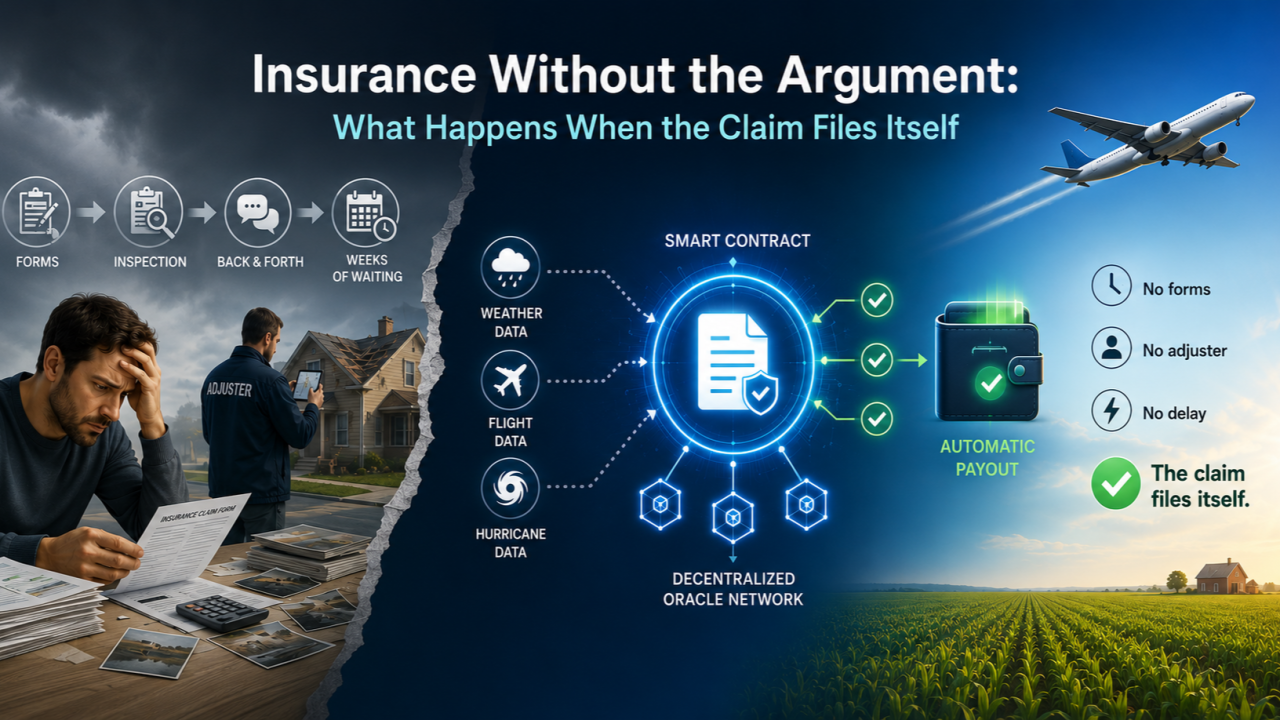
Ask anyone who has filed an insurance claim what they remember most, and it’s rarely the payout. It’s the process: the forms, the adjuster visit, the back-and-forth over how much damage actually occurred, the weeks of waiting while a human decides whether your version of events matches theirs.
Parametric insurance removes the argument entirely, by removing the thing people were arguing about.
A different question, not a faster answer to the same one
Traditional insurance asks: how much damage did you actually suffer? That question requires inspection, documentation, negotiation, and judgment, which is exactly why claims take weeks and why disputes are common. Parametric insurance asks a completely different, much narrower question: did a specific, predefined, externally verifiable event occur? If a flight was delayed past four hours, if rainfall in a given location dropped below a set threshold, if a hurricane’s measured wind speed crossed a line, the policy pays out, full stop. As one breakdown of the model puts it plainly, with parametric crop insurance a farmer does not need to prove a crop failed, they only need to prove it didn’t rain.
That single shift, from assessing damage to checking a fact, is what makes automation possible. Insurance is fundamentally rule-based: if a flight is delayed by more than four hours, the passenger gets paid, automated, with no human decision required.
How the contract actually knows what happened
The obvious problem is that a blockchain has no way of knowing whether it rained, or whether a flight landed late. Since blockchains are isolated networks, they cannot natively access real-world information like weather data, stock prices, or flight statuses. This is solved by oracles: services that fetch external data and feed it into the smart contract to trigger actions.
In practice this means three concrete steps. A decentralized oracle network fetches data from a trusted source, the smart contract compares that data against the agreed threshold, and if the condition is met, the contract releases funds immediately to the policyholder’s wallet. For crop insurance, the trigger is a weather oracle confirming rainfall dropped below a defined threshold at a farm’s GPS coordinates. For flight delay coverage, the policy activates when live flight data shows a delay beyond a set number of hours, and the policyholder files nothing. For natural catastrophe products, payouts trigger when verified wind speed exceeds a predefined level.
This isn’t theoretical. AXA ran a flight delay product that monitored flight status through oracle data feeds and paid out automatically without any claim filing, which achieved high customer satisfaction for its simplicity, though it was eventually discontinued for being unprofitable rather than for any technical failure. Arbol is a cleaner live example on the crop side: their policy details are encoded in smart contracts, priced using an AI underwriter, and connected to Chainlink oracles that pull real-time weather data. When rainfall drops below a predefined threshold or temperatures fall outside agreed bounds, the contract pays out automatically with no field inspection or paperwork required. In March 2025 they added IoT sensor data and machine learning to their trigger design, and they have since expanded into on-chain parametric reinsurance with a live production platform, covering not just individual farmers but the insurers behind them using the same oracle-and-smart-contract stack. The value for smallholders is particularly stark: it is estimated that more than $1 trillion of the world’s crops are currently uninsured, largely because the administrative cost of traditional indemnity coverage makes it uneconomical to serve small farms at all.
The honest caveat: the oracle is the new weak point
It would be misleading to present this as a solved problem. Moving the point of judgment from a human adjuster to a data feed doesn’t eliminate risk, it relocates it. Smart contracts rely on external data feeds to trigger claims, but those oracles can potentially be compromised or manipulated, an attacker controlling weather data could trigger fraudulent crop payouts, and flight delay insurance could be exploited if airline databases are hacked. The standard defense is redundancy: using multiple independent oracle sources and building in dispute resolution mechanisms for suspicious claims, rather than trusting any single feed unconditionally. Even with safeguards, oracle sources can occasionally conflict with each other, and when disputes do occur, resolution may require falling back to manual adjudication that takes days or weeks, partially undoing the speed advantage the model is built on.
There’s also a regulatory dimension worth naming honestly: in markets like the US, parametric products settled in digital assets currently sit in a gray zone between insurance and financial derivatives, since federal law hasn’t yet built a clear framework for them, which is why much of the current activity runs through specific licensing arrangements rather than mainstream insurers.
Why this matters beyond the novelty
The momentum here isn’t speculative. The parametric insurance market is projected to grow from roughly $21 billion in 2026 to nearly $39 billion by 2030, and the practical results already back that up: early blockchain-based travel insurance products have processed the majority of eligible claims within 48 hours, a timeline that would be unthinkable for adjuster-based claims.
The pattern worth watching isn’t really “insurance on a blockchain.” It’s a broader template: any agreement where payment should depend on an objectively verifiable fact rather than someone’s interpretation of a more complicated reality. Insurers already recognize this isn’t an all-or-nothing leap. The practical advice from infrastructure providers is to start with narrow use cases where triggers are objective and measurable, pair smart contracts with traditional policy documentation to preserve enforceability, and choose oracle providers with redundancy built in from the outset, treating this as an incremental upgrade to existing infrastructure rather than a wholesale replacement of it.
For an industry whose core product is, fundamentally, a promise to pay under specific conditions, this is one of the more natural fits smart contracts have found outside of pure finance. The interesting question isn’t whether this works for flight delays and crop drought. It’s how many other “promise to pay if X happens” relationships are sitting around waiting for the same treatment.
This is the third in a twelve-part series on smart contract use cases beyond the well-known examples of DeFi and NFTs. Previous: No Middlemen, No Chasing Invoices. Next: Your Payslip Is Not Their Business.