AI Didn't Create Your Security Problem — It Just Found It
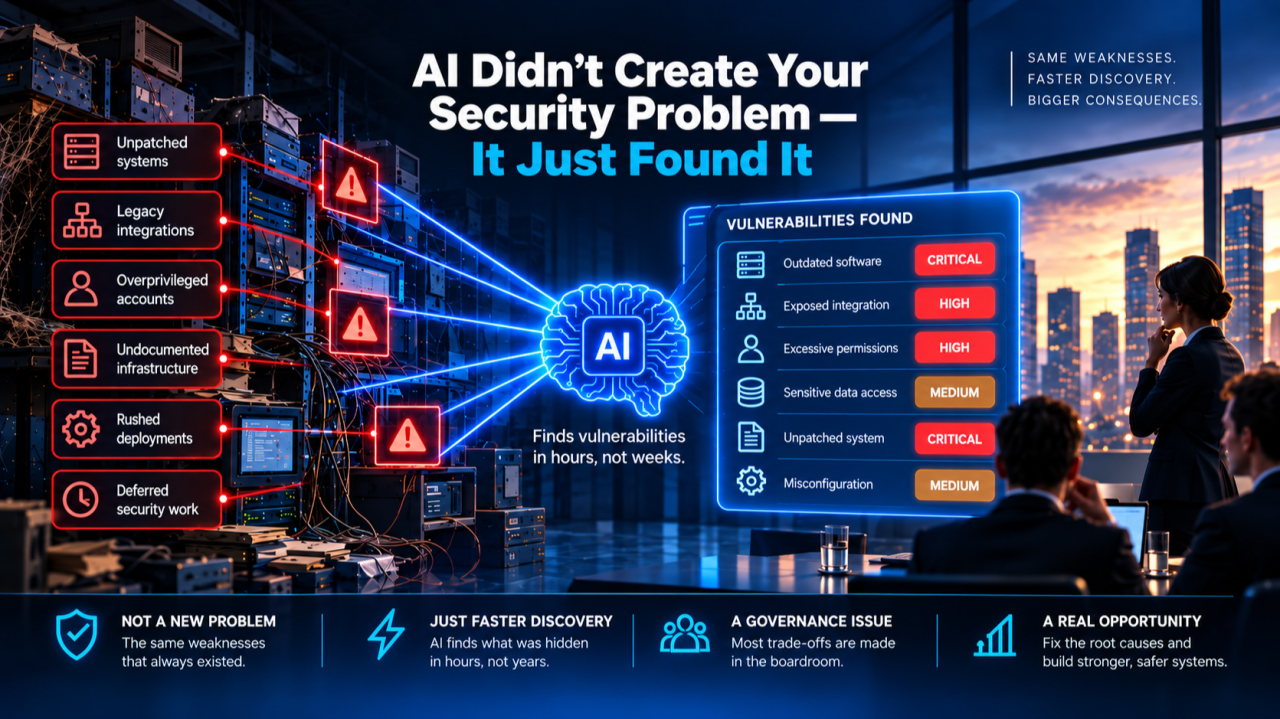
Ask an executive what worries them about AI and security, and you’ll hear about deepfake fraud, AI-written malware, phishing at scale. All real. But focusing there misses the more uncomfortable truth: AI isn’t inventing new weaknesses in your organization. It’s finding the ones that were already there, faster than anyone ever could before.
Old debt, new auditor
Unpatched systems, undocumented legacy integrations, overprivileged accounts, this is old news to any CISO. It was tolerable for years because exploiting it took an attacker time, skill, and patience, and attackers were resource-constrained too. AI collapses that cost. Reconnaissance that took a skilled team weeks now takes hours. A company that got away with poor hygiene for a decade isn’t suddenly more careless, it’s exposed because the price of finding its weak points just dropped close to zero.
Equifax is the case study everyone already knows, and it’s worth revisiting for exactly this reason. In March 2017, Apache disclosed a critical flaw in its Struts framework and shipped a patch the same day. Equifax’s own security team sent an internal notice telling staff to patch within 48 hours. The patch was never applied to the vulnerable system. Two months later, attackers walked in through that exact hole and spent 76 days inside, undetected, before anyone noticed. No AI was involved on either side. What failed was patch management, asset visibility, and internal follow-through, three unglamorous, entirely human process failures. Today, an AI-assisted attacker finds that same unpatched, internet-facing system in a fraction of the time it took a human red team in 2017. The debt didn’t change. The time it takes to get caught did.
Technical debt is a decision, not an accident
Every piece of that debt was approved by someone. Ship the feature now, refactor later. Keep the acquired company’s legacy stack instead of redesigning it. Delay the upgrade because the system “still works.” These looked like reasonable trade-offs against a deadline or a budget cycle. AI is now the mechanism that reveals which of those bets have quietly run out of runway.
There’s a particular version of this that repeats in almost every organization: the project is behind schedule, the go-live date was promised upward or to the market, and something has to give. Security testing, hardening, and the less visible parts of the architecture are the easiest things to cut, because a missed deadline is visible to everyone immediately and a security gap is invisible until someone finds it. So the date gets saved and the gap gets shipped, quietly rebranded as “we’ll close that in a follow-up phase,” a phase that competes for funding and attention against the next deadline, and often never comes.
Budget is the comfortable excuse
“We didn’t have the budget for security” is an appealing explanation, it’s blameless, and it sounds fixable with a bigger line item next year. But most exposure traces back to decisions that had nothing to do with money: choosing the faster integration over the hardened one, deprioritizing a warning from technical staff, treating a compliance checklist as equivalent to actual security. More budget without better decision-making just buys more tools that get misconfigured, or ignored the same way the last set was.
The real gap is at the table where decisions get made
Boards and executives are approving AI rollouts, vendor consolidations, and infrastructure cuts without always having the grounding to know what they’re trading away. This isn’t a call for executives to learn to code. It’s that when someone in the room says “that system is isolated, it’s fine” or “we’ll patch it next cycle,” too often nobody present can evaluate whether that’s actually true. So, it goes unchallenged, and it becomes the next Equifax.
It isn’t only misunderstanding, it’s mistrust
Give leadership credit for more instinct than they’re usually granted: often the warning does land, and gets discounted anyway. A security team asking for time to patch, or flagging a shortcut as risky, can read to an executive as reflexive caution, empire-building, or a team protecting its own workload rather than the business. The technical view gets treated as one interest group’s opinion among several, not as a fact about how exposed the company is. It’s the one voice in the room that’s easiest to overrule, because nobody else can check its math. That instinct isn’t irrational; technologists do sometimes overstate risk. But when it hardens into a habit of discounting technical warnings by default, it’s no longer skepticism, it’s a standing decision to fly blind.
Fixing this isn’t mainly about better reporting, friendlier dashboards, or teaching security teams to speak “the language of the business.” Those help at the margins, but they treat the symptom. The real fix is structural: putting technical matters where they actually belong in the hierarchy of business concerns, which for most organizations is no longer a support function reporting a few layers down, but close to the center of how the business survives. Most organizations today are still led by executives who came up through finance, sales, operations, or general management, in eras when a technical failure was a cost center’s problem, not an existential one. That model made sense when technology supported the business. It stops making sense once technology, and increasingly the AI built on top of it, is the business, its product, its exposure, and often its single largest source of unpriced risk. Closing the trust gap means giving technical leadership a standing seat where strategy and risk are actually decided, not a rotating slot on the agenda to explain themselves before the “real” decisions get made.
As AI gets embedded deeper into products and workflows, the decisions about what data it touches, what permissions it inherits, and how its failures are handled are made at exactly this level. The gap between approving the rollout and understanding what was approved is where tomorrow’s exposure is quietly accumulating, and it stays open as much by choice as by ignorance.
What this actually means
The danger of AI in IT security isn’t mainly that AI attacks you. It’s that AI is a stress test, one that finds every corner that was ever cut, at a speed that no longer gives you years to notice. Most of those corners were cut in the boardroom, not the server room. The fix isn’t a bigger security budget line, and it isn’t a training course for executives either. It’s recognizing that technical debt is a governance issue, and that governance only works once technical judgment sits where the decisions are actually made rather than being consulted after the fact. The organizations that adjust that structure will treat the next Struts-style flaw as a Tuesday. The ones that don’t will keep discovering, one AI-accelerated breach at a time, that the gap was never technical, it was where technology sat at the table.