Why Nations Fail?... and Why Companies Fail?
Why nations fail?
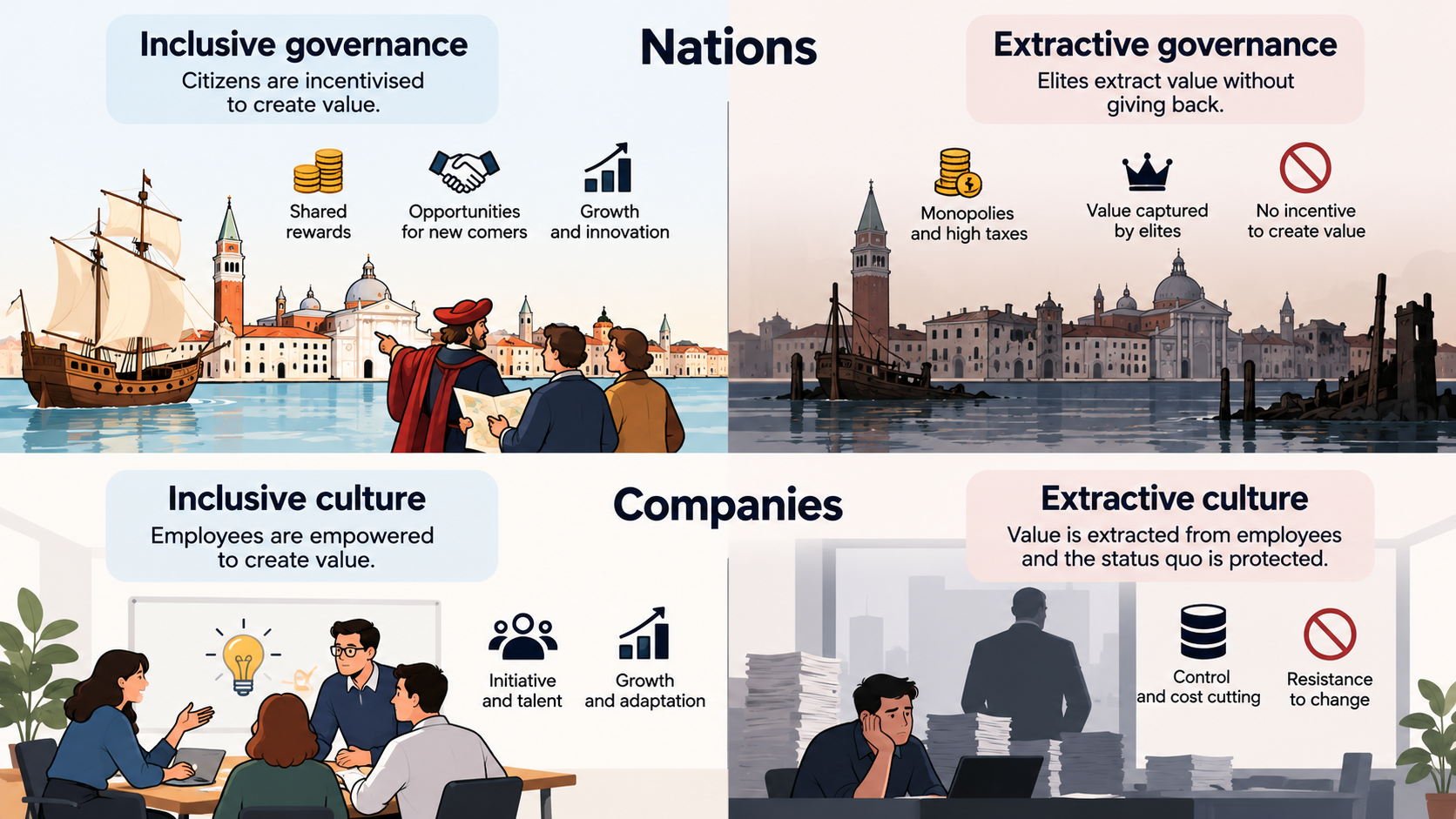
In this very inspiring book, Why Nations Fail?, Daron Acemoglu and James Robinson demonstrate, through a number of in-depth examples, that disappeared civilizations failed because they were unable to incentivize their citizens to create value.
Extractive civilizations are the ones where elites try to extract as much value as possible from citizens without giving anything back. Value is extracted not only through taxes, but also by redirecting all possible value toward the elites, controlling monopolies, disregarding property rights, and in some cases not even respecting their citizens' human rights.
In such a context, why would citizens be motivated to put in the effort to generate value, when that value will simply be captured by the elite?
Among the many examples the authors use to illustrate this theory, one is particularly fascinating: the Venetian Republic. This small city-state managed, within a remarkably short time, to expand its influence across the entire Mediterranean — and then, in an even shorter time, it collapsed completely.
Why?
Venice's success came from an inclusive governance model, in which citizens were rewarded for the value they helped generate. Venice invented the joint venture: a shared model between navigators and merchants, designed to incentivize navigators to explore and trade with remote countries. Successful explorers returning to Venice received a fair share of the proceeds, and gained influence within the city, since the governance model stayed open to newcomers.
This illustrates the idea of creative destruction, coined by Joseph Schumpeter.
Of course, creative destruction comes at the expense of established players, which is exactly why elites grow increasingly reluctant to support it. They have climbed the ladder, and they don't want to be challenged — or worse, replaced by newcomers.
This is exactly why, after years of success, the Venetian Republic failed: governance changes halted the inclusion of newcomers, locking in a status quo among the established players. This froze innovation and growth, and led, remarkably quickly, to decline.
What about companies?
A strong parallel can be drawn with companies, which resemble states in this respect: they set up a governance model that can be more extractive or more inclusive. When small, they tend to favor initiative and growth, and lean inclusive. Later, once established, they become extractive — squeezing as much value as possible out of their employees and defending the status quo, which in the end makes them irrelevant.
This theory of inclusive versus extractive approaches also explains the success of transformational leadership, which aims to develop employees rather than simply extract value from them.