Blockchain deploiement
A very promising technology
As mentioned already a few times here, blockchain is a very promising technology, particularly for financial services. In a recent study, the consulting firm Oliver Wyman suggests that by 2020, banks could save between $15-20B per year in infrastructure costs using blockchain.
At the recent finnovasia meeting, Stephens from UBS confirmed that blockchain will bring real disruption.
But some limiting factors
This will not be achieved without using the technology at full scale: the less native the implementation, the more effort will be needed to ensure consistency with existing systems. But some factors limit full adoption — some ecosystems are quite complex. Securities, for example, involve many actors working together (clearers, exchanges, custodians, brokers...), which means a fully native implementation requires agreement among all these actors on a single standard.
Those ecosystems have been built incrementally over decades, if not centuries. As described in a previous post, banks will need to define an integration strategy to gradually expand blockchain's grip.
Not a global deployment, but some starting points identified
A global deployment of such a disruptive technology is quite unlikely (also due to the blooming landscape of competing technology offerings). But in the finnovasia session on blockchain, as reported by Coindesk, some starting points have been identified:
- Stephens for UBS said that blockchain will replace several hundred internal ledgers.
- Alex Edana, WIP Solutions CEO, said: "Australia will be the first market on the blockchain in three to five years. There, you only have [a small number of] banks and a couple of exchanges."
This reinforces the idea that the smaller, the easier: small ecosystems like Australia, with less legacy to work around, will adopt blockchain faster.
It also shows there is a benefit for large organizations in adopting the technology internally to rationalize their own processes. Remember that large organizations do a lot of trading internally, particularly between sales and trading desks. Those trades are booked in each branch and need to be reconciled constantly.
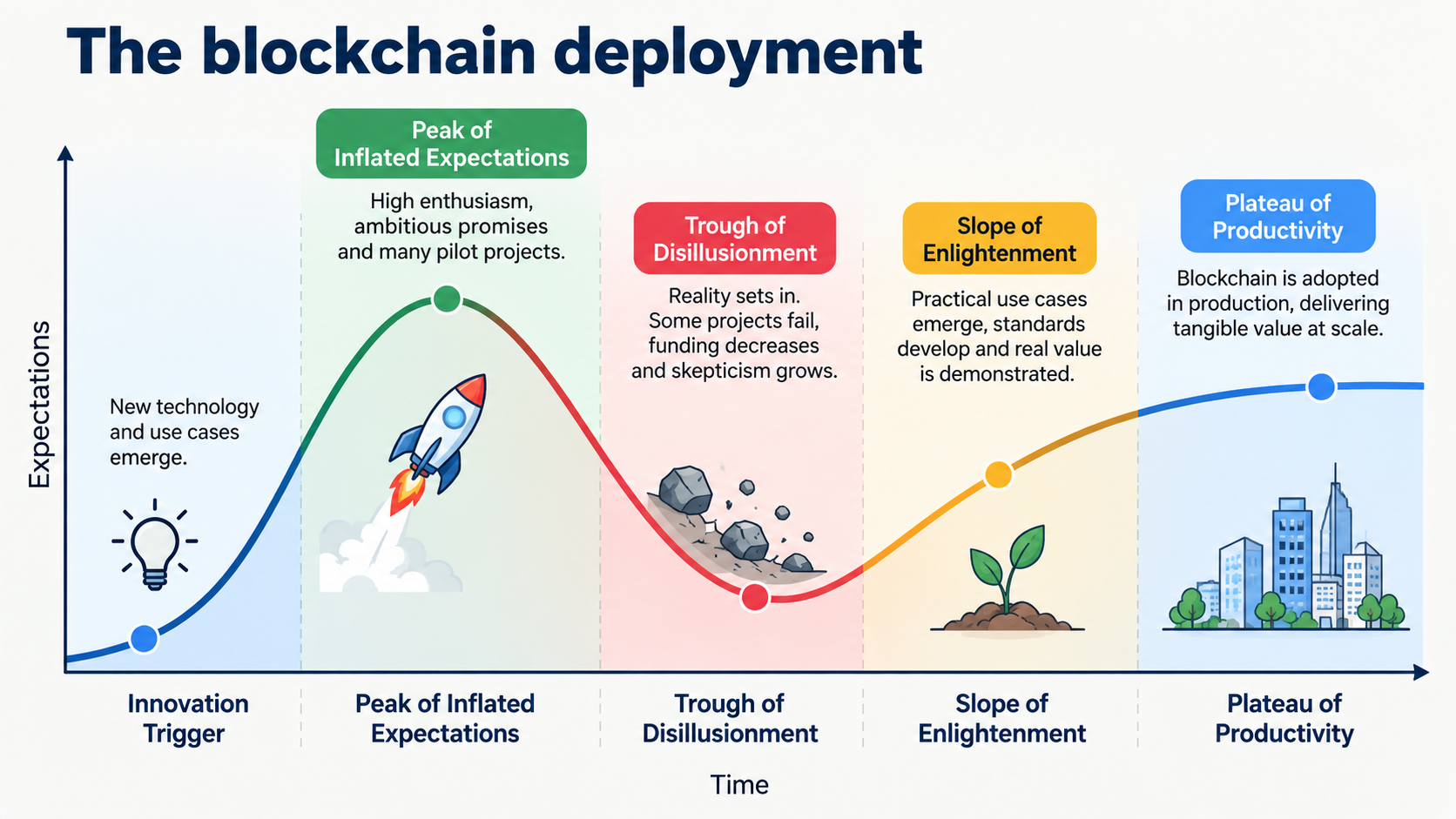
Hype curve?
 |
| Hype curve @Wikipedia |
This phenomenon in technology adoption is well known, and blockchain will be no exception: hype will grow, early implementations will be partial, returns will disappoint, and the hype will drop sharply. Then, little by little, small-scale projects will demonstrate returns and grow incrementally.
"Rome was not built in one day."