Blockchain Integration Strategy
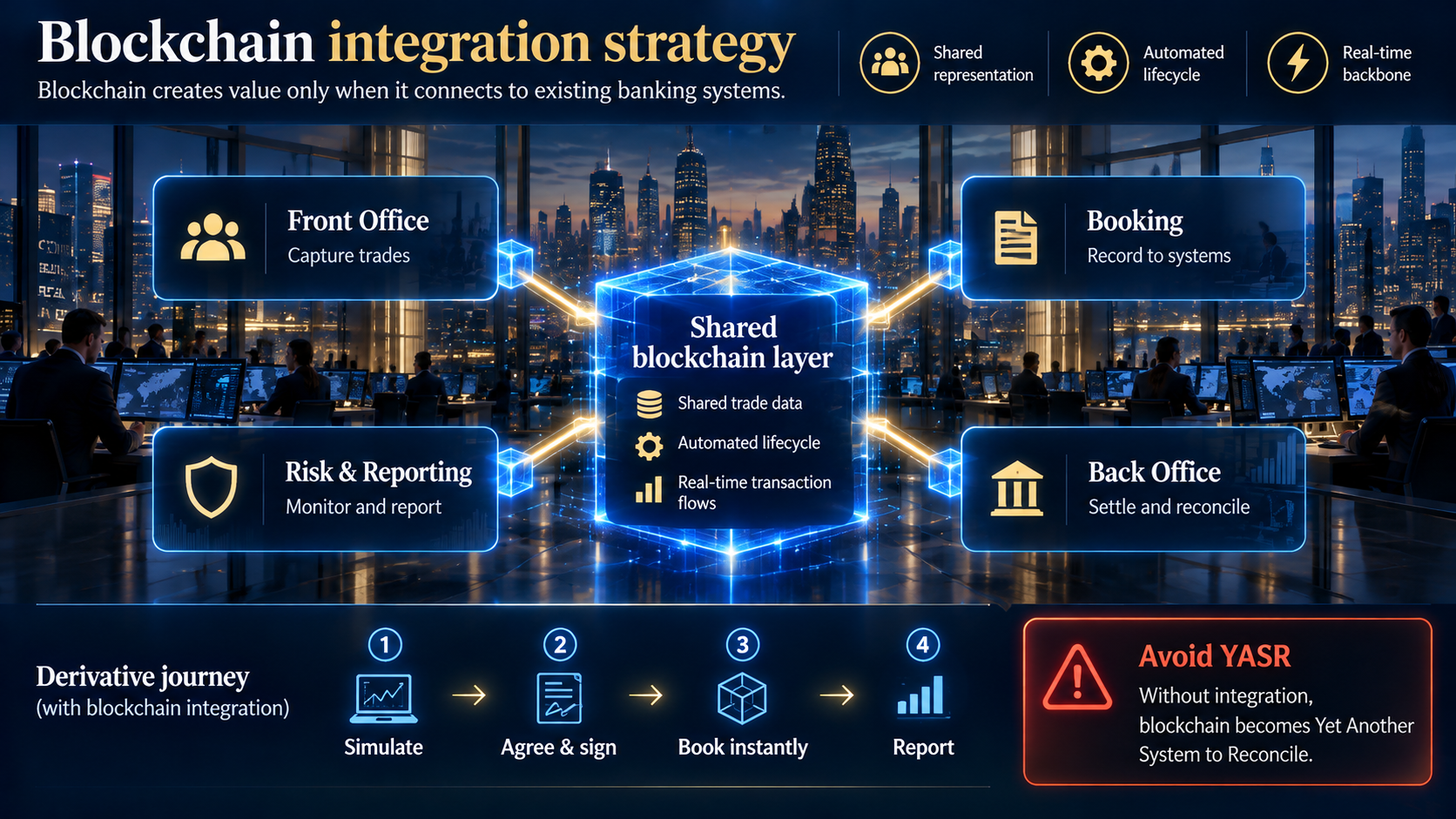
Blockchain technology is generating a lot of hype, particularly in financial services, where it's often envisioned as the magic solution to every inefficiency in back-office processes.
It's true that those processes are sub-optimal, and that blockchain can bring a lot of optimization — but it should not be considered a magic wand.
What blockchain and smart contracts bring
Functionally, the potential is huge:
- A shared trade representation between buyer and seller, cutting out the tedious reconciliations performed at multiple levels.
- Full life-cycle management of products through automated contracts, shared between buyer and seller.
- A real-time transaction backbone supporting all types of flows — money, securities, contracts, and more.
This will only deliver real efficiencies if the blockchain ledger is seamlessly integrated with the components banks already have in place.
Example: a derivative contract
To illustrate this, take a derivative contract. Blockchain could help at several points along its life:
- At the front-office level, simulating the product with the customer instead of exchanging Excel-based term sheets.
- Once the product is fully defined and agreed, blockchain allows instantaneous booking, with the transaction signed by both parties — the seller in creating the product and the buyer in buying it.
- The code defining the product generates all the flows for the different events along its lifecycle — coupons, barriers, termination, and so on.
- Reporting becomes much easier too, since the transaction database is open and available to any application — even, potentially, to the regulator.
Integration is not optional
As this high-level example shows, blockchain touches all of a bank's activities, from front office to accounting. Will the promise be delivered if blockchain is implemented as a separate system? Definitely not.
Without integration into the existing landscape, blockchain becomes just another YASR — Yet Another System to Reconcile — bringing some value but also creating extra work to keep it consistent with everything else. Alongside the proofs of concept banks are now running, they should be mapping out the integration path with existing systems: accounting, market data, back and front office, and — not to be forgotten — risk and reporting.
Skip those steps, and blockchain's full power will never be released.